
Most people don’t struggle with knowing what to do.
They struggle with starting.
They know they should:
- Go for the walk
- Tidy the room
- Make the phone call
- Work on the project
- Cook something decent for dinner
But when the moment comes, the energy just isn’t there.
And sometimes it shows up.
But most of the time, it doesn’t.
This is where a very simple idea can change everything.
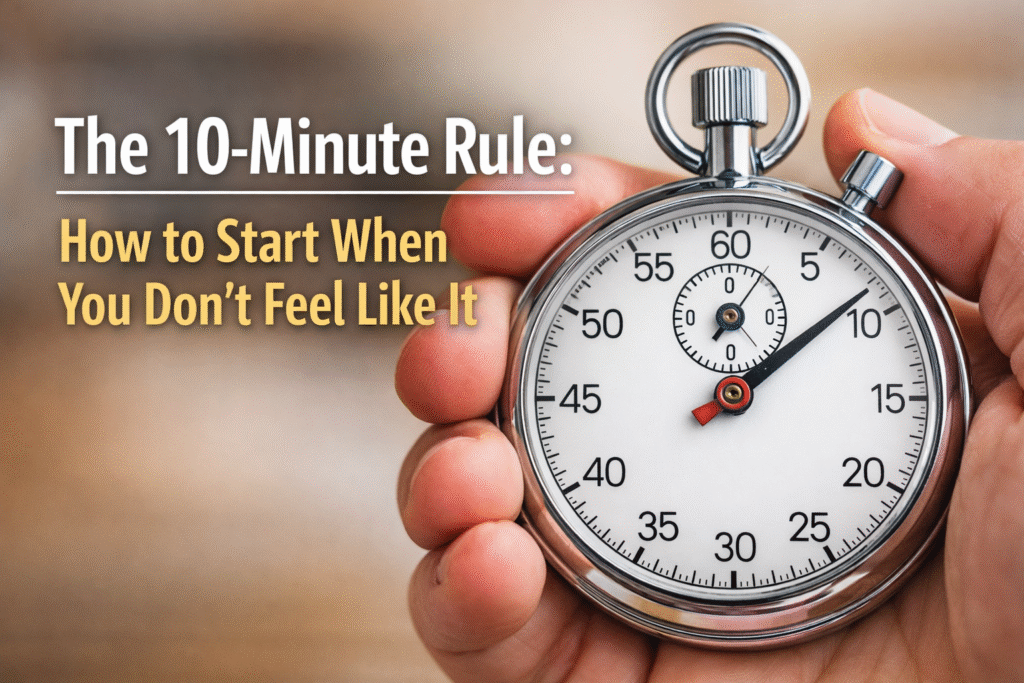
It’s called the 10-Minute Rule.
What the 10-Minute Rule Is
The rule is simple:
Commit to doing the task for just ten minutes.
Not the whole job.
Not the perfect version.
Not until it’s finished.
Just ten minutes.
After ten minutes, you’re allowed to stop. No guilt. No negotiation.
That’s the entire agreement.
Why This Works So Well
When we avoid something, it’s rarely because the task itself is impossible.
It’s usually because:
- It feels too big
- It feels endless
- We imagine it being harder than it is
- We think we have to do it perfectly
Our brains resist anything that looks overwhelming.
But ten minutes doesn’t look overwhelming.
Ten minutes is:
- One song on the radio
- A short walk around the block
- A small patch of dishes
- A single email
- A quick tidy of one surface
Ten minutes feels possible, even on a low-energy day.
And “possible” is the doorway to consistency.
The Real Magic of the First Ten Minutes
Here’s what often happens.
You start the task, slightly reluctantly, with the promise that you can stop soon.
Then one of two things occurs:
1. You stop after ten minutes.
And that’s fine. You still showed up. You still kept the habit alive.
2. You keep going.
Because starting was the hardest part, not the doing.
Either way, you win.
The goal isn’t to finish everything.
The goal is to build the identity of someone who starts.

This Isn’t About Productivity
The 10-Minute Rule isn’t a productivity hack.
It’s a kindness strategy.
It recognises that:
- You’re human
- Your energy fluctuates
- Some days are heavier than others
- And pressure usually makes things worse
Instead of demanding heroic effort, it offers a gentle entry point.
Just start small.
Just start briefly.
Just start.
Where to Use the 10-Minute Rule
You can use this rule anywhere motivation tends to disappear:
- Exercise: walk for ten minutes
- Housework: tidy one area
- Work: focus on one task
- Paperwork: open the letter and read it
- Personal goals: write a few lines
The point is not to impress yourself.
The point is to keep the rhythm of showing up.
A Quiet Shift in Thinking
Instead of asking:
“Do I feel motivated enough to do this?”
Try asking:
“Can I give this ten minutes?”
That question is gentler.
And it leads to far more action.
Because most of the time, the barrier isn’t the task itself.
It’s the starting.

Try This Today
Pick one thing you’ve been putting off.
Set a timer for ten minutes.
Start.
When the timer goes off, you get to decide:
- Stop, with no guilt
- Or keep going
Either choice is a success.
Because you didn’t wait for motivation.
You chose movement instead.
And that’s how consistency is built—one small start at a time.
A gentle next step
If you’re finding it hard to start, or you keep circling the same goals without real movement, it can help to talk things through with someone outside your day-to-day life.
Coaching isn’t about pressure or big dramatic changes. Often it’s just a steady conversation that helps you see what matters, choose one small step, and keep moving.
If you’d like that kind of support, you’re welcome to book a conversation with me. We’ll look at where you are, what feels stuck, and what a realistic next step might be.
No pressure. Just a calm place to start.

Years ago, I moved to North Carolina after living in Chicago, which had sidewalks and parks to run in. I now needed to drive at least 10 miles to get to somewhere I could run for marathon training. I had run about 40 marathons and maybe 3 ultras by that time.
Then I happened upon a blog that advocated just getting out the door for 10 minutes; then I could stop or keep going, at least I’d gotten in some training. It made such a difference in my mindset! If I’d spent 10 minutes driving and 10 minutes running then I was happy to get my training run in!
I’m now 73 and have run 98 marathons in 42 States and 9 ultras, and can’t do that distance anymore but it is real delight to have those memories.
I still use the 10 minute rule when I just don’t wanna get the run in.
Hi Anne,
What an incredible story — 98 marathons in 42 States at 73! That is extraordinary.
I love how you brought this back to something so simple: not motivation, not perfect conditions… just getting out the door for 10 minutes. That’s exactly it. The power isn’t in the distance — it’s in lowering the barrier.
Your move from Chicago to North Carolina is such a great example of how circumstances change. Sidewalks disappear. Parks aren’t around the corner anymore. Bodies age. But the principle still holds: start small, remove the drama, and begin. It’s amazing how often action creates energy, not the other way around.
And I think there’s something really beautiful in what you said — even when the distances aren’t what they used to be, the habit and the mindset remain. That’s a lifelong win.
Thank you so much for sharing this. Stories like yours show that the 10-minute rule isn’t a “trick” — it’s a way of living.
With warmth,
Megan