
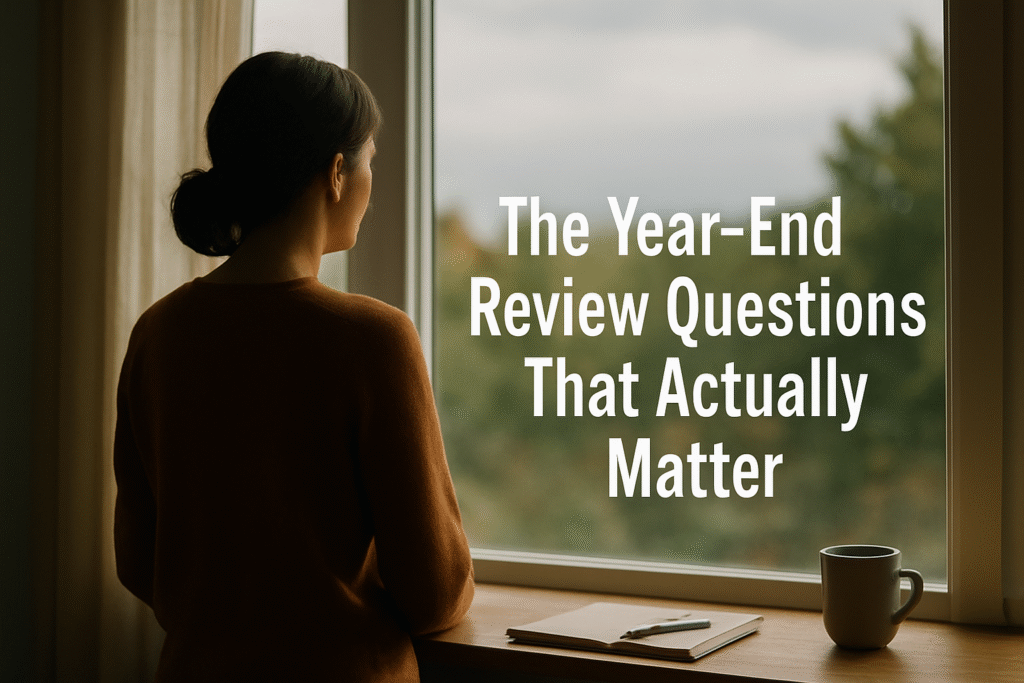
We’re in that strange pocket of time between “how is it almost the end of the year?” and “what am I going to do differently next year?” If you’re anything like me, you’ve probably seen those 50-question year-end reviews floating around social media — the ones that ask you to remember what you ate on February 14th or list every book you read since January.
But year-end review questions don’t need to be overwhelming to be useful. The right questions can help you notice what mattered, what changed, what surprised you, and what you want to carry forward.
Here’s the thing: those marathon reflection sessions can feel more like homework than helpful. And honestly? Most of us abandon them halfway through, feeling vaguely guilty about not remembering enough details or not achieving enough to make our answers sound impressive.
But year-end reflection doesn’t have to be exhausting. In fact, the most meaningful reviews are often the simplest ones. So let’s skip the overwhelming lists and focus on a handful of questions that actually help you understand your year—and yourself—a little better.
Year-End Review Questions That Actually Matter
1. What surprised me this year?
Start here because surprises tell us something important: they show us where life didn’t follow our script. Maybe you discovered you actually enjoyed something you thought you’d hate. Maybe a friendship deepened in unexpected ways, or maybe you handled a challenge better than you thought you could.
Surprises reveal growth we didn’t plan for and joys we weren’t looking for. They remind us that life is bigger than our to-do lists. When I ask myself this question, I’m always amazed by how much happened that wasn’t on my radar at all in January.
2. What did I learn about myself?
Not “what did I learn” in general—but specifically about you. What patterns did you notice? What situations brought out your best self? What drained your energy faster than you expected?
Maybe you learned you need more alone time than you thought. Maybe you discovered you’re braver than you gave yourself credit for. Or maybe you realized that saying yes to everything doesn’t actually make you happy—it just makes you tired.
These insights are gold. They’re the kind of self-knowledge that helps you make better decisions going forward, not because you’re trying to fix yourself, but because you’re learning to work with who you actually are.
3. What am I proud of that nobody else would think to celebrate?

This one’s important because we often overlook our quietest victories. Yes, maybe you got a promotion or ran a marathon—those are great. But what about the Tuesday morning you got out of bed even though you really didn’t want to? The conversation where you set a boundary for the first time? The day you chose rest over productivity guilt?
Some of our proudest moments are invisible to everyone else. They’re the small choices that took real courage, the daily persistence that nobody saw, the internal shifts that changed everything even though nothing changed on the outside.
Give yourself credit for those. They count.
4. What do I want to feel more of next year?
Notice this isn’t “what do I want to do more of” or “what do I want to achieve.” It’s about feelings. Because at the end of the day, all our goals and plans are really just attempts to feel a certain way.
Do you want to feel more peaceful? More connected? More energized? More creative? More grounded? When you get clear on the feeling you’re chasing, you can find multiple paths to get there. You don’t need one perfect plan—you need to know what you’re actually after.
I’ve found that when I focus on how I want to feel, my decisions get easier. It becomes clearer what to say yes to and what to politely decline.
5. What’s one thing I’m ready to let go of?

This is the question we avoid because it feels like admitting defeat. But letting go isn’t failure—it’s wisdom. It’s recognizing that not everything that once served you still does. Not every goal needs to be carried forward. Not every habit deserves another year.
Maybe you’re ready to let go of a grudge that’s been weighing you down. Maybe it’s a goal that was never really yours in the first place. Maybe it’s the belief that you have to have everything figured out.
Letting go creates space. And sometimes space is exactly what we need.
Why These Questions Work
These year-end review questions work because they bring you back to awareness instead of achievement.
You might have noticed something about these questions: none of them require you to measure yourself against external standards. There’s no “did I achieve enough?” or “am I where I should be?”
That’s intentional.
The most meaningful reflection isn’t about comparison—it’s about understanding. It’s not about judgment—it’s about awareness. When we stop trying to grade ourselves and start trying to know ourselves, reflection becomes something that actually helps instead of something that just makes us feel inadequate.
These questions also don’t require perfect memory. You don’t need to have tracked your whole year in a journal or remember every detail. Your gut knows the answers. The moments that mattered will surface when you give them space to.
Actually Doing This (Without Overthinking It)
Here’s my suggestion: don’t treat this like an assignment. You don’t need to sit down and write essay-length responses to each question. You don’t need to do it all in one sitting.
You can use these year-end review questions slowly, one at a time, rather than trying to complete them all in one sitting.
Instead, try this: pick one question and let it sit with you for a few days. Notice what comes up while you’re doing the dishes or driving to work. Maybe jot down a thought or two when something surfaces, but don’t force it.
The point isn’t to produce the perfect reflection document. The point is to notice, to learn, and to carry forward what matters.
If you want to deepen this practice, the Greater Good Science Center also has helpful resources on gratitude and noticing what is good in your life.
The Real Gift of Reflection

Year-end review isn’t about proving you made the most of your time or holding yourself accountable to impossible standards. It’s about paying attention to your own life—really paying attention—so you can show up for the next year with a little more wisdom, a little more self-compassion, and a little more clarity about what actually matters to you.
You’ve lived through another entire year. That’s worth noticing. Not with pressure or judgment, but with genuine curiosity about who you’ve become along the way.
So here’s to a review that actually helps. Here’s to questions that matter. And here’s to carrying forward only what serves you.
Ready to turn your reflections into action? My recent goal setting series covers everything from creating goals that matter to you through to actually achieving them:
- Goal Setting with Purpose: The Ultimate Guide to Goals That Stick
- SMART vs HEART Goals: Which Framework Works Best for You?
- How to Find Your Core Values (and Why They Matter for Goal Setting)
- Accountability and Reflection: The Secret Sauce of Goal Achievement
- Breaking Big Goals Into Small Steps: The Key to Actually Achieving Them
What surprised you most this year? I’d love to hear—hit reply and share one thing that caught you off guard in 2025.

Megan Ruffino is a professional life coach, Master NLP Practitioner and trainer who writes about happiness, self-coaching and personal growth. She helps people understand themselves more clearly, make conscious choices and take practical steps toward lives that feel happier and more empowered.