Have you ever caught yourself doing something and thought:
Why do I keep doing this?
Maybe you procrastinate, even though the task matters to you.
Maybe you overreact to a comment that probably wasn’t meant to hurt you.
Maybe you say yes when you mean no.
Maybe you start strong with a new habit, then slowly drift back into old patterns.
Maybe you promise yourself, This time I’ll be different, only to find yourself back in the same familiar loop.
This is where the Iceberg Model can be so useful.
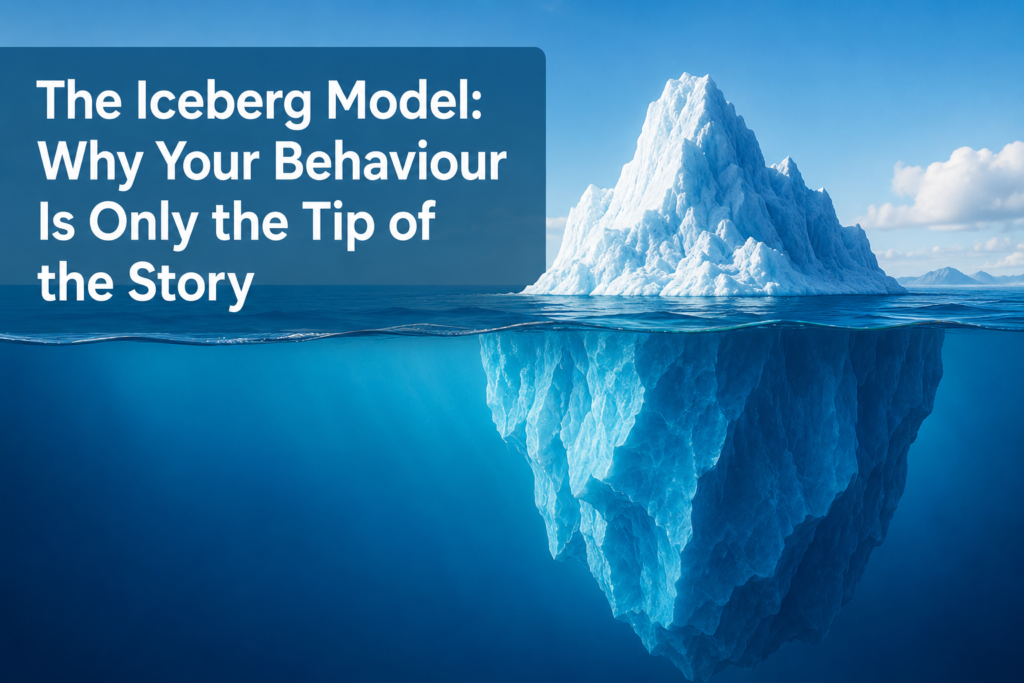
The Iceberg Model is a simple coaching model that helps us understand why we do what we do. It is often used in coaching, personal development, leadership, and behaviour change because it reminds us that visible behaviour is rarely the whole story.
In a previous article, I wrote about the GROW Model and how to coach yourself through a problem. The GROW Model is useful when you want to move from confusion to action. The Iceberg Model is useful when you want to understand what may be sitting underneath the behaviour, reaction, or pattern you are trying to change.
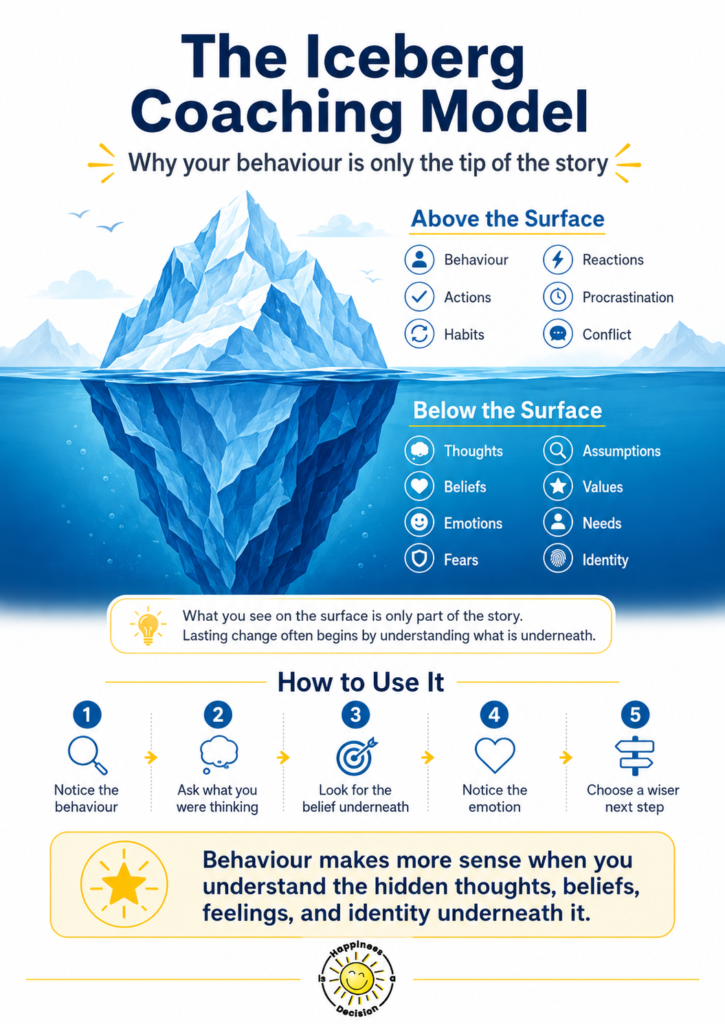
What people see on the surface — our actions, habits, choices, reactions, avoidance, procrastination, conflict, or emotional outbursts — is usually only the tip of the iceberg.
Underneath that visible behaviour may be thoughts, beliefs, values, fears, assumptions, emotional patterns, past experiences, needs, and identity.
In other words, the thing we are doing is often connected to something deeper.
And that matters because if we only try to change the behaviour on the surface, we may miss what is keeping the pattern alive underneath.
It can be tempting to focus only on the visible behaviour.
The procrastination.
The emotional reaction.
The avoidance.
The people-pleasing.
The self-sabotage.
The unfinished project.
The argument.
The late-night scroll.
The second helping.
The silence when you really wanted to speak.
But behaviour is rarely the whole story.
The Iceberg Model helps us pause and ask a better question:
What is happening beneath the surface?
That does not mean we excuse every behaviour.
It does not mean we avoid responsibility.
It means we get curious enough to understand the deeper driver, instead of just attacking the visible symptom.
Because telling yourself to “just stop it” is rarely a long-term growth strategy.
It is more like yelling at the smoke alarm because you do not like the noise.
The noise matters. But the real question is: what set it off?
What Is the Iceberg Model?
The Iceberg Model is a coaching tool for exploring the hidden layers beneath behaviour.
Imagine an iceberg floating in the ocean.
The part above the water is what everyone can see.
But most of the iceberg is hidden beneath the surface.
Human behaviour works in a similar way.
The Iceberg Model is also used in systems thinking as a way of looking beneath visible events to the patterns, structures, and mental models that may be shaping them.
What we see on the surface might be:
- actions
- habits
- reactions
- choices
- conflict
- procrastination
- avoidance
- emotional outbursts
- repeated patterns
But underneath the surface may be:
- thoughts
- beliefs
- values
- fears
- assumptions
- expectations
- emotional patterns
- past experiences
- needs
- identity
- self-image
So when you ask, “Why do I keep doing this?” the answer is usually not found only in the behaviour itself.
The more useful coaching question is:
What is happening beneath the surface?
That question can help you move from judgement to understanding.
And from understanding, you can begin to choose a wiser response.
Not a perfect response.
Not a magically transformed, halo-glowing, green-smoothie version of yourself.
Just a wiser one.
That is often where real change begins.
Here’s a simple visual summary of the Iceberg Coaching Model:
The Part Everyone Sees: Behaviour
Behaviour is the part of the iceberg above the water.
It is what other people notice.
It is what we often judge ourselves for.
For example:
- “I keep procrastinating.”
- “I always get defensive.”
- “I can’t stick to a routine.”
- “I avoid difficult conversations.”
- “I get overwhelmed too easily.”
- “I keep choosing the wrong people.”
- “I start things but never finish them.”
- “I know what I should do, but I don’t do it.”
These behaviours can be frustrating, especially when we genuinely want to change.
But behaviour is usually not random.
It is often an attempt to meet a need, avoid pain, protect ourselves, stay safe, feel accepted, preserve identity, or manage emotion.
That does not mean the behaviour is helpful.
It means it may be serving a purpose.
And until we understand that purpose, we may keep trying to change at the wrong level.
Beneath the Surface: Thoughts and Beliefs
Under many behaviours are thoughts and beliefs.
Sometimes we are aware of them.
Often we are not.
This also connects closely with the Think, Feel, Act Cycle, which explores how our thoughts influence our feelings, actions, and results. The Iceberg Model gives us another way to look at those hidden thoughts and beliefs before they turn into visible behaviour.
A person who procrastinates may not simply be “lazy”.
Underneath the procrastination might be the belief:
- “If I try and fail, it will prove I’m not good enough.”
- “I have to do this perfectly or not at all.”
- “I don’t know where to start.”
- “This is too much for me.”
- “People will judge me if it isn’t good.”
- “I always mess things up.”
A person who says yes when they want to say no may not simply have “poor boundaries”.
Underneath the yes might be:
- “If I disappoint people, they will reject me.”
- “My needs are less important than everyone else’s.”
- “Good people are always helpful.”
- “I am only valued when I am useful.”
- “Conflict means something is wrong.”
A person who reacts strongly to criticism may not simply be “too sensitive”.
Underneath the reaction might be:
- “I am being attacked.”
- “I am not safe.”
- “I have failed.”
- “They are going to leave.”
- “I must defend myself quickly.”
This is why the Iceberg Model is so helpful.
It asks us to stop staring only at the behaviour and start asking better questions about what is driving it.
Why Willpower Is Not Always Enough
Willpower has its place.
Sometimes we really do need discipline, structure, and follow-through.
There is nothing wrong with deciding to take action even when we do not feel like it.
But willpower is often overrated as a complete solution.
If your behaviour is being driven by fear, shame, old beliefs, identity, or emotional protection, willpower alone may not be enough.
You might force yourself to act differently for a while, but eventually the deeper pattern pulls you back.
This is one reason people can know exactly what they “should” do and still not do it.
They know they should have the conversation.
They know they should stop overcommitting.
They know they should apply for the job.
They know they should rest.
They know they should stop checking their phone.
They know they should finish the project.
But knowing is not always the same as feeling safe enough, worthy enough, clear enough, or supported enough to act differently.
That is not an excuse.
It is information.
And good self-coaching begins with information, not self-attack.
A Simple Iceberg Example: Procrastination

Let’s look at procrastination through the Iceberg Model.
Above the surface, the behaviour is:
I am putting off the task.
That is the visible part.
But underneath, there could be many different drivers.
Maybe the person is thinking:
- “I don’t know how to do this.”
- “This will take too long.”
- “I’ll probably get it wrong.”
- “I need a big block of uninterrupted time.”
- “I have to feel motivated first.”
Maybe they believe:
- “If I can’t do it perfectly, there’s no point.”
- “I’m not disciplined.”
- “I’m bad at this kind of thing.”
- “Other people find this easier than I do.”
Maybe they feel:
- anxious
- overwhelmed
- ashamed
- bored
- resentful
- pressured
Maybe they value:
- doing things properly
- being seen as capable
- not letting people down
- having freedom
- avoiding criticism
Maybe their identity says:
- “I’m not the kind of person who follows through.”
- “I’m a last-minute person.”
- “I always make things harder than they need to be.”
Suddenly procrastination looks less like a simple time-management problem.
It may still need a practical solution, of course. We are not throwing the calendar in the bin and lighting a candle instead.
But the practical solution will work better when it addresses the real issue.
If the real issue is overwhelm, the next step may be making the task smaller.
If the real issue is perfectionism, the next step may be creating a deliberately imperfect first draft.
If the real issue is fear of judgement, the next step may be separating your worth from the outcome.
If the real issue is confusion, the next step may be asking for help or defining the first clear action.
Same behaviour.
Different causes.
Different solutions.
That is the point.
A Simple Iceberg Example: People-Pleasing
People-pleasing is another behaviour that makes more sense when we look beneath the surface.
Above the surface, the behaviour might be:
I said yes when I wanted to say no.
It is easy to judge that.
“Why didn’t I just say no?”
“Why am I like this?”
“Why do I always do this?”
But underneath that yes may be a whole hidden world.
Thoughts:
- “They’ll be upset with me.”
- “It’s easier to just do it.”
- “I don’t want to cause trouble.”
- “I should be able to manage.”
Beliefs:
- “Good people don’t disappoint others.”
- “My needs are selfish.”
- “Keeping the peace is my job.”
- “If I say no, I’ll lose connection.”
Emotions:
- guilt
- fear
- anxiety
- pressure
- resentment
Values:
- kindness
- loyalty
- responsibility
- harmony
- generosity
Identity:
- “I’m the reliable one.”
- “I’m the strong one.”
- “I’m the helper.”
- “I’m not someone who lets people down.”
This is why people-pleasing can be so hard to shift.
It is not just about learning a better sentence.
Although that helps.
It is also about questioning the belief that your worth depends on being endlessly available.
It is about learning that kindness without honesty often becomes resentment in a cardigan.
And nobody needs more resentful cardigan energy.
The Iceberg Model and Limiting Beliefs
The Iceberg Model links beautifully with limiting beliefs because limiting beliefs often sit beneath repeated patterns.
A limiting belief is a belief that restricts what we think is possible, acceptable, safe, or available to us.
Some common limiting beliefs include:
- “I’m not good enough.”
- “I always fail.”
- “I’m too old to change.”
- “I’m not confident.”
- “I can’t trust myself.”
- “People like me don’t succeed.”
- “If I rest, I’m lazy.”
- “If I speak up, I’ll be rejected.”
- “I have to do everything myself.”
These beliefs often operate quietly in the background.
We may not consciously say them out loud.
But they still shape our choices.
If you want to explore this more deeply, you may also find it helpful to read The Think, Feel, Act Cycle – A Deep Dive on Thoughts, where I explain how the sentences running through our minds can shape the way we feel and behave.
A person who believes “I’m not good enough” may avoid opportunities.
A person who believes “I have to do everything myself” may refuse support.
A person who believes “If I rest, I’m lazy” may burn out and call it discipline.
A person who believes “I can’t trust myself” may constantly seek reassurance.
This is why self-awareness matters.
Not fluffy self-awareness where we sit around admiring our own complexity forever.
Useful self-awareness.
The kind that helps us notice the hidden belief and ask:
Is this actually true?
Where did I learn this?
Is it helping me now?
What might be a more honest and useful belief?
Why Change Can Feel Threatening
One of the most important things the Iceberg Model shows us is that change is not always resisted because we are weak or lazy.
Sometimes change feels threatening because it challenges something underneath the surface.
For example, setting a boundary may challenge the belief:
“I am only lovable when I am easy to deal with.”
Resting may challenge the belief:
“My value comes from being productive.”
Trying something new may challenge the identity:
“I’m not the kind of person who takes risks.”
Speaking honestly may challenge the assumption:
“Conflict means rejection.”
Receiving help may challenge the belief:
“I should be able to cope on my own.”
This is why growth can feel uncomfortable even when it is healthy.
You are not just changing a behaviour.
You may be changing the deeper story you have been living from.
That takes courage.
It also takes patience.
Because the old pattern may have protected you at some point.
It may have helped you belong, stay safe, avoid criticism, keep peace, or feel in control.
The question is not, “What is wrong with me?”
The better question is:
What has this pattern been trying to do for me, and is it still the best way?
How To Use the Iceberg Model as a Self-Coaching Tool

You can use the Iceberg Model whenever you notice a behaviour or reaction you want to understand.
Here is a simple process.
Step 1: Name the Visible Behaviour
Start with what is happening on the surface.
Try to describe it without drama or judgement.
It can help to separate the facts of what happened from the thoughts you are having about it. I explain this more in The Think, Feel, Act Cycle – A Deep Dive on Circumstances.
For example:
- “I avoided making the phone call.”
- “I snapped at my partner.”
- “I said yes when I wanted to say no.”
- “I put off starting the project.”
- “I kept checking my phone.”
- “I withdrew instead of saying what I felt.”
Keep it factual.
Not “I’m hopeless.”
Not “I always ruin everything.”
Just the behaviour.
That alone is a small act of sanity.
Step 2: Ask What You Were Thinking
Next, ask:
What was I thinking in that moment?
Write down the thoughts that were running through your mind.
They might be messy, unreasonable, emotional, or contradictory.
That is fine.
You are not writing a legal statement. You are noticing the weather inside your own head.
Examples:
- “This is too hard.”
- “They’ll be angry.”
- “I don’t know what to say.”
- “I’ll look stupid.”
- “I can’t handle this.”
- “It won’t make any difference anyway.”
Do not rush to correct the thoughts yet.
First, notice them.
Step 3: Look for the Belief Underneath
Now ask:
What would I have to believe for this behaviour to make sense?
This is a powerful question.
If you procrastinated, what belief made avoidance feel safer?
If you overreacted, what belief made defence feel necessary?
If you said yes, what belief made no feel dangerous?
If you stayed silent, what belief made honesty feel risky?
Possible beliefs might include:
- “I’m not capable.”
- “Other people’s needs matter more than mine.”
- “Mistakes are unacceptable.”
- “I have to keep everyone happy.”
- “I can’t cope with conflict.”
- “If I fail, it means something bad about me.”
This is often where the real gold is.
Not shiny, comfortable gold perhaps.
More like finding an old rusty tin under the house — not pretty, but possibly full of useful clues, old stories, and information you can finally use.
That is where change often begins.
Step 4: Notice the Emotion
Ask:
What emotion was present?
Common answers might include:
- fear
- shame
- guilt
- sadness
- anger
- resentment
- anxiety
- overwhelm
- disappointment
- loneliness
Emotion often gives us clues about what matters.
Fear may point to a need for safety.
Anger may point to a crossed boundary.
Guilt may point to a value, a belief, or an old pattern of responsibility.
Sadness may point to loss or longing.
Overwhelm may point to too much pressure and not enough support.
The goal is not to drown in the emotion.
The goal is to listen to what it may be telling you.
Step 5: Identify the Need or Value
Ask:
What need or value might be underneath this?
For example:
- The need for safety
- The need for rest
- The need for respect
- The need for belonging
- The need for clarity
- The need for support
- The need for autonomy
- The value of honesty
- The value of kindness
- The value of excellence
- The value of responsibility
This step matters because many unhelpful behaviours are distorted attempts to protect something important.
People-pleasing may come from valuing kindness and connection.
Perfectionism may come from valuing excellence.
Avoidance may come from needing safety.
Overworking may come from valuing responsibility.
The value may be good.
The strategy may be the problem.
That distinction is important.
You do not have to throw away your kindness to stop people-pleasing.
You do not have to stop caring about quality to loosen perfectionism.
You do not have to become careless to stop over-functioning.
You may simply need a healthier way to honour the value.
Step 6: Choose a Better Response
Finally, ask:
What would be a wiser next step?
Not a perfect next step.
Not a dramatic life overhaul.
Just a wiser one.
Examples:
- “I will send the message instead of avoiding it.”
- “I will ask for ten minutes to think before answering.”
- “I will do a messy first draft.”
- “I will say, ‘I can’t take that on this week.’”
- “I will take a short walk before responding.”
- “I will ask one clarifying question.”
- “I will rest without earning it first.”
The aim is not to bully yourself into change.
The aim is to understand the pattern clearly enough that you can choose differently.
That is how self-coaching becomes practical.
Iceberg Model Self-Coaching Questions
Here are some questions you can use in your journal or notes app.
Choose one behaviour or reaction you want to understand, then ask:
- What happened on the surface?
- What did I do, avoid, say, or not say?
- What was I thinking at the time?
- What was I feeling?
- What did I believe about myself, the other person, or the situation?
- What was I afraid might happen?
- What need was I trying to meet?
- What value was I trying to protect?
- What old story might be active here?
- Is this story completely true?
- Is this behaviour helping me become the person I want to be?
- What is one wiser response I could practise next time?
You do not need to answer every question every time.
This is not a tax return.
Start with the question that opens something useful.
A Word of Caution: Do Not Turn the Iceberg Into a Weapon
There is one trap with models like this.
Once we learn that behaviour has deeper causes, we can start over-analysing everything.
We can also start using insight as another form of self-criticism.
“Well, clearly I’m procrastinating because I have unresolved fear and a limiting belief and an identity wound and now I’m even more annoyed with myself.”
No thank you.
That is not the point.
The Iceberg Model is not there to make you feel more defective.
It is there to help you become more curious, honest, and effective.
Curiosity creates more movement than shame.
Shame usually makes people hide, defend, collapse, or repeat the same pattern with extra misery sprinkled on top.
Curiosity asks:
What is really going on here?
That question has power.
When Self-Coaching May Not Be Enough
The Iceberg Model can be very useful for self-reflection, journaling, coaching, and personal development.
But there are times when self-coaching may not be enough.
If the behaviour or reaction is linked to trauma, abuse, addiction, severe anxiety, depression, self-harm, or a situation where you do not feel safe, it is important to seek appropriate professional support.
Self-awareness is powerful, but you do not have to do deep emotional work alone.
Sometimes the bravest and most practical next step is getting the right help.
Sometimes self-coaching is enough to help you pause, reflect, and choose a wiser next step.
And sometimes it helps to have someone beside you.
If you find yourself circling the same patterns, asking the same questions, or knowing what you “should” do but still feeling stuck, coaching can give you a supportive space to slow down, think clearly, and see what may be happening beneath the surface.
You do not need to have everything figured out before you ask for support.
That is often the point of coaching.
If you would like help exploring your own patterns, beliefs, choices, and next steps, you are welcome to learn more about working with me.
Final Thoughts
Your behaviour is only the tip of the story.
The visible part matters, of course.
What you do still has consequences.
Your habits, choices, reactions, and patterns shape your life.
But if you want real change, it helps to look beneath the surface.
Not so you can excuse yourself.
Not so you can blame the past.
Not so you can spend the next decade analysing why you are the way you are while still avoiding the dishes.
But so you can understand yourself clearly enough to choose differently.
The Iceberg Model reminds us that behaviour usually makes sense when we understand the thoughts, beliefs, emotions, values, fears, and identity beneath it.
And once we can see the deeper pattern, we are no longer just reacting.
We are learning.
We are choosing.
We are growing.
That is where change becomes possible.
Not by attacking the tip of the iceberg.
But by understanding what has been hidden underneath the water.
A Simple Practice for This Week
Choose one behaviour you keep judging yourself for.
Write it at the top of a page.
Then ask:
What might be underneath this?
Let the answers come honestly.
No performance.
No pretending.
No self-bullying dressed up as motivation.
Just curiosity.
Then choose one small, wiser action.
That is enough for today.
Because sometimes the first step in changing your behaviour is not forcing yourself harder.
Sometimes it is finally understanding the story beneath it.
This is one of several practical tools you can use to coach yourself through change. Visit my complete guide to self-coaching to explore the process and find the model that best suits what you are working through.
If the idea of learning how to coach yourself with practical tools and support appeals to you, add your name to the Self-Coaching Studio interest list and I’ll keep you updated as it develops.

Megan Ruffino is a professional life coach, Master NLP Practitioner and trainer who writes about happiness, self-coaching and personal growth. She helps people understand themselves more clearly, make conscious choices and take practical steps toward lives that feel happier and more empowered.