
There are times in life when you know something needs to change, but you cannot quite work out what to do next.
You might feel stuck in a job that no longer fits. You might want to improve your health, but keep falling back into old habits. You might have a decision to make and find yourself going around in circles. You might be tired of reacting the same way, repeating the same patterns, or promising yourself that “this week will be different” only to find yourself back where you started.
This is where the GROW Model can be useful.
The GROW Model is a simple life coaching framework that helps you think through a problem clearly. It gives you a structure for moving from confusion to clarity, and from clarity to action. It does not magically solve your problems for you — sadly, no coaching model comes with a wand, a fairy godmother, or a fully staffed admin department — but it can help you stop swirling in your own thoughts and start seeing your next step.
The GROW Model can be used in a coaching session with a life coach, but it can also be used as a self-coaching tool. If you have never experienced life coaching before, this model is a helpful place to begin because it is practical, easy to understand, and useful for everyday problems.
What Is the GROW Model?
The GROW Model is a coaching framework that helps you work through a problem, goal, decision, or area of life where you feel stuck.
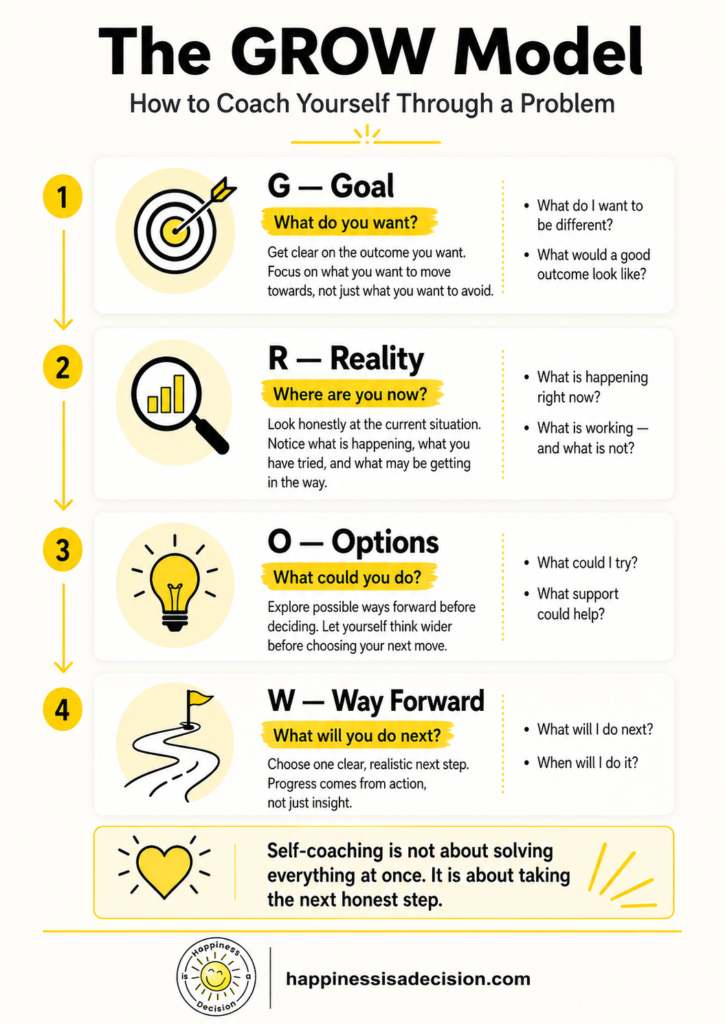
GROW stands for:
G — Goal
What do you want?
R — Reality
Where are you now?
O — Options
What could you do?
W — Way Forward
What will you do next?
At its heart, the GROW Model helps you answer four very human questions:
What am I trying to achieve?
What is actually happening?
What choices do I have?
What am I willing to do now?
That may sound simple, but simple does not mean shallow. In fact, one of the reasons the GROW Model is so helpful is because it stops you from jumping straight into action before you have properly understood the problem.
Many people try to solve problems by starting at the end. They leap straight into, “What should I do?” before asking, “What do I actually want?” or “What is really going on here?”
That is a bit like trying to use a map without knowing your destination or your current location. You can move very enthusiastically in completely the wrong direction. Plenty of people do.
The GROW Model helps you pause long enough to get your bearings.
Why the GROW Model Helps When You Have a Problem
When people feel stuck, they often believe the problem is that they do not know what to do. Sometimes that is true. But very often, the deeper problem is that they have not clearly defined what they want, they are not being fully honest about where they are, or they are only considering one or two options.
The GROW Model helps because it creates space between the problem and the reaction.
Instead of spinning in thoughts like, “I don’t know what to do,” “I should be further ahead by now,” or “Everything is too hard,” the model gives you a calm structure to follow. It brings your thinking out of the fog and onto the page.
This is especially useful when you are dealing with everyday life problems such as changing habits, making decisions, managing overwhelm, improving relationships, building confidence, setting boundaries, starting a project, or working out your next step.
The GROW Model is not about forcing yourself into action before you are ready. It is about helping you see more clearly, think more honestly, and choose a step that makes sense.
That is important because coaching is not just about motivation. Motivation is lovely when it turns up, but it is not always reliable. Some days motivation arrives late, wearing odd socks, and carrying excuses. A good coaching model does not depend on you feeling inspired. It gives you a way to move forward even when your thoughts are messy and your confidence is wobbling.
Download the Free GROW Model Worksheet
A simple printable worksheet to help you work through a problem, get clear, and choose your next step.

Step 1: Goal — What Do You Want?
The first stage of the GROW Model is Goal.
This is where you ask yourself what you want to achieve, change, understand, or decide. It sounds obvious, but many people skip this step. They focus on what is wrong, what they hate, what they are tired of, or what they want to avoid.
That is understandable. Pain usually gets our attention before possibility does.
But coaching begins to shift something when you move from “I don’t want this” to “What do I want instead?”
For example, you might start with:
“I don’t want to feel so overwhelmed.”
That is a valid starting point, but it is not yet a clear coaching goal. A more useful goal might be:
“I want to create a calmer weekly routine so I feel more in control of my time.”
Or:
“I want to understand what is causing my overwhelm and choose one practical change I can make this week.”
A good goal does not have to be enormous. In fact, smaller and clearer is often better. “Change my whole life” may sound impressive, but it is not very useful when you are standing in the kitchen at 9 pm wondering why you still have not done the thing you promised yourself you would do.
A useful goal is specific enough that you can work with it.
Goal Questions to Ask Yourself
What do I want to be different?
What would I like to understand more clearly?
What would a good outcome look like?
If this problem improved, what would I notice?
What do I want instead of what is currently happening?
What would be a realistic goal for now?
When you are setting your goal, try to focus on something within your influence. This does not mean everything is your fault or your responsibility. It simply means your coaching work will be more useful if it focuses on what you can think, choose, practise, change, communicate, or do.
For example, “I want my boss to stop being difficult” may be understandable, but it is not fully within your control. A more useful coaching goal might be, “I want to decide how to respond more calmly and clearly when my boss is difficult.”
That gives you somewhere to work.
Step 2: Reality — Where Are You Now?
The second stage of the GROW Model is Reality.
This is where you look honestly at what is currently happening. Not what you wish was happening. Not what you think should be happening. Not the polished version you would tell someone at a barbecue while pretending everything is fine. The real version.
This step matters because you cannot move forward from where you are pretending to be. You can only move forward from where you actually are.
The Reality stage helps you gather information. It asks you to look at your current situation, your habits, your thoughts, your feelings, your obstacles, your resources, and your patterns.
For example, if your goal is to create a calmer weekly routine, the Reality stage might reveal that you are saying yes to too many things, checking your phone constantly, not planning meals, sleeping poorly, and expecting yourself to function like a well-oiled machine when you are actually running on crumbs and caffeine.
That is not a character flaw. It is information.
This is one of the most valuable parts of coaching. You begin to see the situation more clearly without immediately attacking yourself for being human.
Reality Questions to Ask Yourself
What is happening right now?
What have I already tried?
What is working?
What is not working?
What keeps getting in the way?
What patterns do I notice?
What am I avoiding?
What am I telling myself about this situation?
What facts do I know, and what stories am I adding?
What support, skills, time, energy, or resources do I already have?
The Reality stage requires honesty, but not brutality. You are not cross-examining yourself like a hostile barrister. You are trying to understand the truth so you can make better choices.
There is a difference between honest self-reflection and self-criticism. Honest self-reflection says, “This is what is happening.” Self-criticism says, “This is happening because I am useless.” One gives you information. The other gives you a headache.
Stay with the information.
Step 3: Options — What Could You Do?
The third stage of the GROW Model is Options.
This is where you explore possible ways forward. The key word here is explore. You are not committing yet. You are opening the window and letting some fresh air into your thinking.
When people feel stuck, they often believe they have no options. But sometimes they have more options than they can see because stress narrows their thinking. They may be trapped in all-or-nothing thoughts such as:
“I have to fix everything or there’s no point.”
“I either do it perfectly or I fail.”
“I have to make the right choice immediately.”
“If I cannot do it all, I may as well do nothing.”
The Options stage helps loosen that grip. It invites you to brainstorm without judging every idea too quickly.
For example, if your goal is to create a calmer weekly routine, your options might include planning meals, saying no to one commitment, going to bed earlier, doing a Sunday reset, asking for help, setting phone boundaries, creating a morning routine, booking exercise into your calendar, or choosing one evening a week with no obligations.
Not every option will be realistic. That is fine. At this stage, you are widening the field.
Options Questions to Ask Yourself
What could I do?
What else could I try?
What have I not considered yet?
What would I suggest to a friend in this situation?
What is the simplest possible step?
What would make this easier?
What could I stop doing?
What could I ask for?
What option feels most realistic?
What option gives me a sense of relief or possibility?
It can also be helpful to ask, “What would I do if I stopped needing the perfect answer?”
Perfectionism often disguises itself as high standards, but sometimes it is just fear wearing a tidy outfit. The Options stage helps you move beyond waiting for the perfect plan and start considering workable possibilities.
Step 4: Way Forward — What Will You Do Next?
The final stage of the GROW Model is Way Forward.
This is where you choose your next step. Not your next seventeen steps. Not your entire life plan. Just the next clear, practical action.
This stage matters because insight without action can become another form of procrastination. It may feel productive to understand yourself deeply, colour-code your notes, and have a lovely little breakthrough while drinking tea. But at some point, change asks for movement.
The Way Forward stage helps you turn reflection into commitment.
A good next step should be clear, realistic, and within your control. It should be small enough that you can actually do it, but meaningful enough that it moves you in the right direction.
For example:
“This week, I will plan three simple dinners before I go grocery shopping.”
“Tonight, I will write down everything I have committed to and choose one thing to cancel or postpone.”
“Tomorrow morning, I will spend ten minutes looking at my calendar before checking social media.”
“I will message my friend and ask if we can walk together on Saturday.”
“I will book a coaching session to talk through this decision instead of continuing to spin in my own head.”
Notice that these actions are specific. “Get my life together” is not a next step. It is a dramatic sigh in sentence form. “Spend 20 minutes reviewing my weekly commitments” is a next step.
Way Forward Questions to Ask Yourself
What will I do?
When will I do it?
How will I make it easier to follow through?
What might get in the way?
How will I handle that obstacle?
Who or what could support me?
How committed am I to this step out of 10?
What would make my commitment one point stronger?
The commitment question is particularly useful. If you choose an action and your commitment is only a 4 out of 10, do not pretend it is a 10. That is how people make plans that look lovely on paper and quietly die by Wednesday.
Instead, adjust the step.
Make it smaller. Make it clearer. Make it more realistic. Make it something you are genuinely willing to do.
Coaching is not about impressing yourself with ambitious plans. It is about building trust with yourself through honest follow-through.
An Example of Using the GROW Model to Coach Yourself Through a Problem
Let’s say you feel stuck because you want to exercise more, but you keep failing to follow through.
You could use the GROW Model like this.
Goal
You might begin with, “I want to exercise more.”
After reflecting, you make it clearer:
“I want to move my body at least three times this week in a way that feels realistic and sustainable.”
That is much more useful. It is specific, but not punishing.
Reality
You then look at what is currently happening.
You realise you have been telling yourself you need to do long workouts, but your schedule is already full. You are tired after work, you dislike crowded gyms, and when you miss one planned session, you tend to think, “I’ve failed again,” and give up for the rest of the week.
You also notice that you do enjoy walking, and you feel better when exercise is simple and outdoors.
Now you have useful information.
Options
You brainstorm possible options.
You could walk for 20 minutes after dinner. You could do a short home workout. You could go to the gym once instead of trying to go four times. You could meet a friend for a walk. You could stretch while watching television. You could put your walking shoes near the door. You could stop aiming for the perfect routine and start with something smaller.
Some options feel unrealistic. Others feel possible.
Way Forward
You choose one clear step:
“This week, I will walk for 20 minutes after dinner on Monday, Wednesday, and Friday. If it rains, I will do 10 minutes of stretching indoors instead.”
That is a practical way forward. It includes a backup plan. It does not require you to become a completely different person by sunrise.
This is the GROW Model doing what it does best: turning a vague wish into a realistic action.
How to Use the GROW Model for Self-Coaching
You do not need a formal coaching session to begin using the GROW Model. You can use it in a journal, on a blank document, or even as a thinking tool when you feel stuck.
The simplest way is to write the four headings on a page:
Goal
Reality
Options
Way Forward
Then answer the questions under each heading.
Try not to rush. The value is not in getting through the model as quickly as possible. The value is in slowing down enough to hear yourself think.
You may find that your first answer is not your real answer. That is normal. Often, the first layer is the familiar complaint, the automatic response, or the answer you think you “should” give. Stay with it a little longer.
For example, you might begin with, “My goal is to stop procrastinating.” But after a few more questions, you realise the real goal is, “I want to understand why I keep avoiding this task and create a less overwhelming way to start.”
That is much more useful.
Self-coaching works best when you are willing to be both kind and honest with yourself. Kindness without honesty can become avoidance. Honesty without kindness can become self-attack. You need both.
Download the Free GROW Model Worksheet
A simple printable worksheet to help you work through a problem, get clear, and choose your next step.
Common Problems the GROW Model Can Help With
The GROW Model can be used for many everyday problems, including feeling overwhelmed, struggling to make a decision, avoiding a task, wanting to change a habit, feeling unsure about a goal, needing to have a difficult conversation, wanting more balance, or trying to rebuild confidence.
It is especially helpful when your thoughts feel tangled. Sometimes the problem itself is difficult. Other times, the bigger problem is that everything is bundled together in your mind: the facts, the fears, the guilt, the pressure, the imagined outcomes, and the old stories you have been telling yourself.
The GROW Model helps you separate these pieces. It gives your thinking somewhere to go.
For example, instead of staying stuck in, “I hate my job,” you might discover:
Goal: “I want to decide whether to stay, leave, or make changes in my current role.”
Reality: “I am tired, under-supported, and bored, but I also need financial stability.”
Options: “I could talk to my manager, update my resume, explore study options, reduce my hours, look for internal opportunities, or set a three-month decision deadline.”
Way Forward: “This week, I will update my resume and write a list of what I want in my next role.”
That is a very different place to be. The whole problem may not be solved, but you are no longer just sitting in the soup.
Common Mistakes When Using the GROW Model
One common mistake is choosing a goal that is too vague. If your goal is something like, “Be happier,” “Get motivated,” or “Fix everything,” you may need to narrow it down. Ask yourself, “What would that look like in real life?” or “What is one area where I want to begin?”
Another mistake is skipping the Reality stage. This often happens when people are uncomfortable facing what is really going on. They want to rush into solutions because the truth feels messy. But the Reality stage is where the gold is. It shows you the patterns, obstacles, and assumptions that are shaping the situation.
A third mistake is judging your options too early. If you dismiss every idea as soon as it appears, you may never give yourself the chance to find a workable path. Let the ideas come first. Evaluation can happen later.
Another mistake is choosing a Way Forward that is too big. Big change usually works better when it is broken into small, repeatable actions. Your next step should be something you can actually do, not something your fantasy self would do after a green smoothie and eight uninterrupted hours of sleep.
The final mistake is using the model only in your head. You can do that, but writing it down is often more powerful. Thoughts can feel convincing when they are swirling around inside your mind. Once they are on paper, you can see them more clearly.
When Self-Coaching May Not Be Enough
The GROW Model is a helpful self-coaching tool, but there are times when working through questions on your own may not be enough.
This is not because you are weak or incapable. It is because human beings are not always great at seeing their own patterns clearly. We all have blind spots. We all have familiar stories we mistake for facts. We all have moments when our emotions are too loud for our wisdom to get a word in.
A coach can help you hear your own thinking more clearly. A good coach will not simply tell you what to do. They will ask useful questions, reflect patterns back to you, challenge assumptions, and help you move from confusion into practical action.
Self-coaching can be a powerful starting point. Coaching with another person can take the process deeper because you are no longer trying to untangle everything from inside your own head.
It is also important to say that coaching is not a replacement for therapy, medical care, financial advice, or legal support. If you are dealing with trauma, mental health concerns, abuse, addiction, crisis, or serious distress, it may be important to seek the right professional support. Coaching can be valuable, but it needs to stay in its lane. The lane is useful. It is just not the whole highway.

A GROW Model Self-Coaching Exercise
Choose one problem you would like to work through. It does not need to be huge. In fact, it may be better to start with something manageable.
Download the Free GROW Model Worksheet
A simple printable worksheet to help you work through a problem, get clear, and choose your next step.
Write your answers to the following questions.
Goal
What do I want to be different?
What would a good outcome look like?
What is one clear goal I can focus on for now?
Reality
What is happening right now?
What have I already tried?
What is working, even a little?
What is not working?
What keeps getting in the way?
What am I telling myself about this?
Options
What could I do?
What else could I try?
What would I suggest to someone I care about?
What is the simplest possible option?
What could I stop doing?
What support could I ask for?
Way Forward
What will I do next?
When will I do it?
What might get in the way?
How will I handle that?
How committed am I to this action out of 10?
What would make it easier to follow through?
Once you have answered the questions, choose one action. Keep it small enough to complete. Then do it.
That is how self-trust is built: not through grand declarations, but through small honest promises kept.
Final Thoughts
The GROW Model is useful because it helps you coach yourself through a problem one step at a time.
It asks you to name what you want, look honestly at where you are, explore your options, and choose a practical way forward. It does not require you to have everything figured out. It simply gives you a place to begin.
And sometimes that is exactly what we need.
Not a perfect plan. Not a total life overhaul. Not another reason to criticise ourselves for being behind.
Just a clear next step.
If you are feeling stuck, try working through the GROW Model on paper. Give yourself time. Be honest. Be kind. Look for the next useful action rather than the perfect answer.
And if you would like support to work through this process with someone else, life coaching can help. A coach can help you clarify what you want, understand what is getting in the way, and take practical steps toward change.
You do not have to stay stuck simply because you cannot yet see the way forward. Sometimes the next step becomes clearer when someone asks the right questions.
Download the Free GROW Model Worksheet
A simple printable worksheet to help you work through a problem, get clear, and choose your next step.
Further Reading
For another simple way to understand how your thoughts shape your actions, you may also like my post on the Think, Feel, Act cycle.
If you want to go deeper into the difference between circumstances and thoughts, this article can help you separate what happened from what you are thinking about it.
You may also like this post on uncovering limiting beliefs if you notice the same patterns getting in your way.
This is one of several practical tools you can use to coach yourself through change. Visit my complete guide to self-coaching to explore the process and find the model that best suits what you are working through.
Want Support With This?
I offer one-to-one coaching for thoughtful people who are ready to turn self-development insight into practical action. If you would like support to understand yourself more clearly, shift unhelpful patterns and move forward in a way that feels intentional and grounded, you are welcome to reach out and book a coaching session.
I am also preparing to launch the Self-Coaching Studio, a membership space for people who want to keep learning and practising tools like this in everyday life. The Studio will include practical self-coaching models, reflection prompts and guided exercises to help you understand yourself, make wiser decisions and create a happier, more intentional life.
If the Self-Coaching Studio sounds like something you would like to be part of, add your name to the interest list and I will keep you updated as it comes together.

Megan Ruffino is a professional life coach, Master NLP Practitioner and trainer who writes about happiness, self-coaching and personal growth. She helps people understand themselves more clearly, make conscious choices and take practical steps toward lives that feel happier and more empowered.