
Most of us like to think we are reasonable people. We want to communicate well. We want to be kind. We want to make mature decisions. We want to respond rather than react. And then someone says the wrong thing at the wrong time, with the wrong tone, on the wrong day, and suddenly our inner wise adult has left the building.
Before we know it, we are blaming, defending, fixing, explaining, withdrawing, rescuing, snapping, over-functioning, or silently rehearsing a speech worthy of a courtroom drama. This is where the Drama Triangle can be useful.
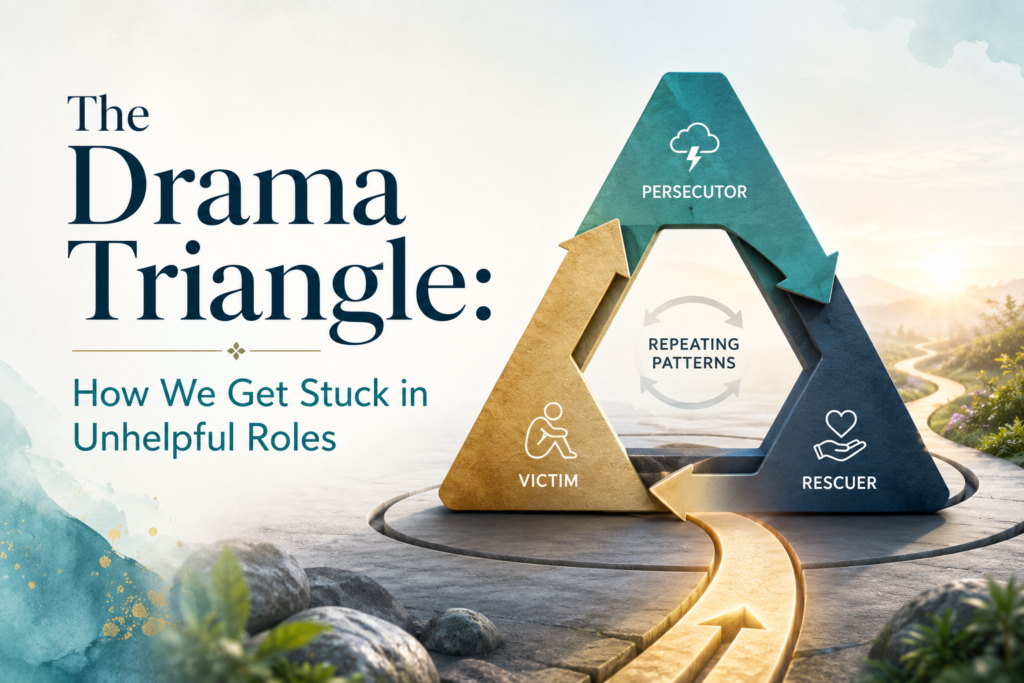
The Drama Triangle is a simple framework that helps us notice three unhelpful roles we can slip into during conflict or emotional stress:
Victim.
Rescuer.
Persecutor.
These roles are not who we are. They are patterns we can fall into. That distinction matters.
This is not about labelling yourself or anyone else as “a victim” or “a persecutor.” It is not about blaming people who have genuinely been hurt, mistreated, or overwhelmed. Real harm exists. Real injustice exists. Real vulnerability exists.
The Drama Triangle is about something more specific: the roles we sometimes unconsciously play when we feel powerless, responsible for everyone, or convinced someone else is the problem. And once we can see the pattern, we have a better chance of stepping out of it.
The three roles of the Drama Triangle
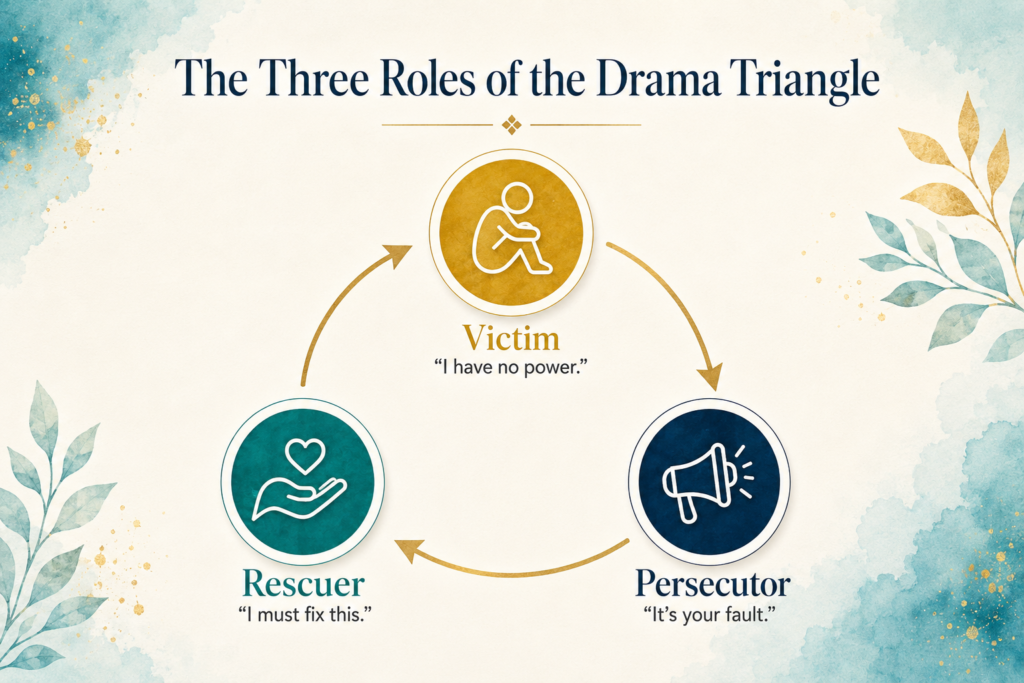
The Drama Triangle has three common roles.
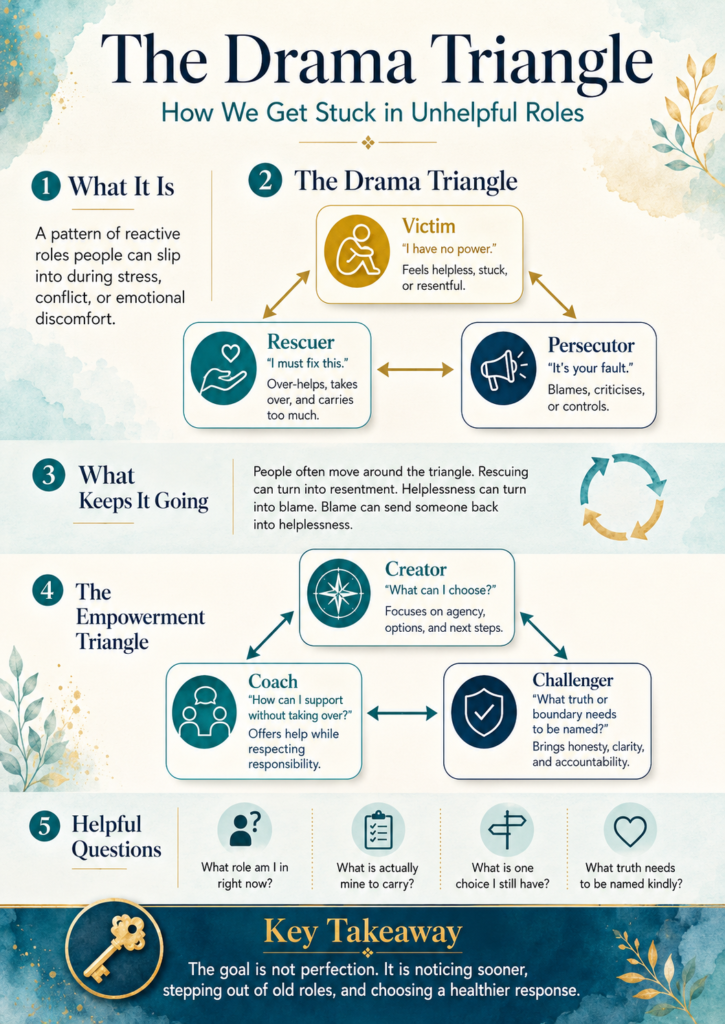
The first is the Victim. The Victim position says, “I have no power.”
This role often sounds like:
“There’s nothing I can do.”
“This always happens to me.”
“No one understands.”
“It’s all too hard.”
“Why bother?”
The Victim role is not the same as being genuinely harmed or struggling. People can experience real pain, real disadvantage, real grief, real trauma, and real difficulty. The Victim role is about the loss of agency. When we are in this role, we may feel helpless, trapped, resentful, or defeated. We may focus so heavily on what is happening to us that we lose sight of what is still within our control.
The second role is the Rescuer. The Rescuer position says, “I must fix this.”
This role often sounds like:
“I’ll sort it out.”
“They need me.”
“If I don’t step in, everything will fall apart.”
“I can’t let them feel upset.”
“It’s easier if I just do it myself.”
At first glance, the Rescuer can look generous, loving, capable, and responsible. And sometimes helping is exactly the right thing to do. But rescuing goes beyond healthy support.
The Rescuer takes over. The Rescuer carries what belongs to someone else. The Rescuer may give help that was not asked for, prevent natural consequences, or become resentful when their effort is not appreciated.
The third role is the Persecutor. The Persecutor position says, “It’s your fault.”
This role often sounds like:
“You never listen.”
“You always ruin things.”
“This is because of you.”
“How could you be so selfish?”
“If you’d just do what I said, we wouldn’t be here.”
The Persecutor role is not the same as holding someone accountable. Accountability can be firm, honest, and necessary. The Persecutor attacks, blames, shames, criticises, or controls.
Sometimes this role is loud and obvious. Other times, it is quieter: eye-rolling, withdrawing affection, sarcasm, contempt, passive aggression, or a tone sharp enough to slice a tomato. Not exactly our finest hour.
Why we move around the triangle
One of the most useful things to understand about the Drama Triangle is that we do not necessarily stay in one role. We can move between them very quickly.
You may begin in the Rescuer role, trying to help someone who seems overwhelmed. Then, when they do not take your advice or appreciate your effort, you may feel like the Victim:
“After everything I’ve done, this is how I’m treated?”
Then you may move into the Persecutor role:
“You’re impossible. You never take responsibility.”
The shift can happen in minutes. Someone else may start in the Victim role, saying they cannot cope. You step in as Rescuer. Then they resent your involvement and accuse you of controlling them. Suddenly, you feel attacked. Now they seem like the Persecutor, and you feel like the Victim. Round and round it goes.
The triangle keeps people emotionally entangled because each role feeds the others. The Victim looks for someone to save them or someone to blame. The Rescuer needs someone to fix. The Persecutor needs someone to criticise or control.
Everyone may feel justified. Everyone may feel misunderstood. Everyone may be reacting from fear, hurt, or frustration. And no one is truly empowered.
How the Drama Triangle shows up in everyday life
The Drama Triangle does not only appear in intense conflict. It can show up in ordinary daily situations.
At work, one person may constantly take over tasks because they believe no one else will do them properly. That is the Rescuer role. Over time, they feel exhausted and unappreciated. Now they feel like the Victim. Eventually, they snap at their team for being useless. Now they are in the Persecutor role.
In families, one person may always smooth things over, manage everyone’s emotions, and prevent difficult conversations. They may tell themselves they are keeping the peace, but they are also carrying responsibility that belongs to others.
In friendships, someone may repeatedly complain about the same problem but reject every possible solution. Another friend may keep offering advice, becoming frustrated when nothing changes.
In personal growth, we may even do this within ourselves. One part of us says, “I can’t do this. I’m hopeless.”
Another part jumps in and says, “Fine, I’ll force us to get organised and fix everything by Monday.”
Then another part attacks: “What is wrong with you? Why can’t you just be disciplined?”
There you are, running an entire Drama Triangle internally before breakfast. Efficient, perhaps. Helpful, not so much.
Why these roles are so seductive
These roles can feel strangely satisfying in the moment.
The Victim role can protect us from the discomfort of responsibility. If I have no power, I do not have to choose. I do not have to risk failure. I do not have to act. I can stay with the familiar story, even if it hurts.
The Rescuer role can make us feel needed. If I am fixing, helping, advising, managing, and saving, I get to feel useful and important. I may also avoid my own needs by focusing on someone else’s life instead.
The Persecutor role can give us a sense of control. If I can blame someone, I can direct my discomfort outward. I do not have to feel my fear, sadness, disappointment, or uncertainty. I can become sharp instead of vulnerable.
That is why awareness matters. We do not usually step into these roles because we are bad people. We step into them because they offer temporary relief. But temporary relief is not the same as freedom.
The Think, Feel, Act Cycle can also help you understand how your thoughts about a situation influence the role you step into.
The Empowerment Triangle
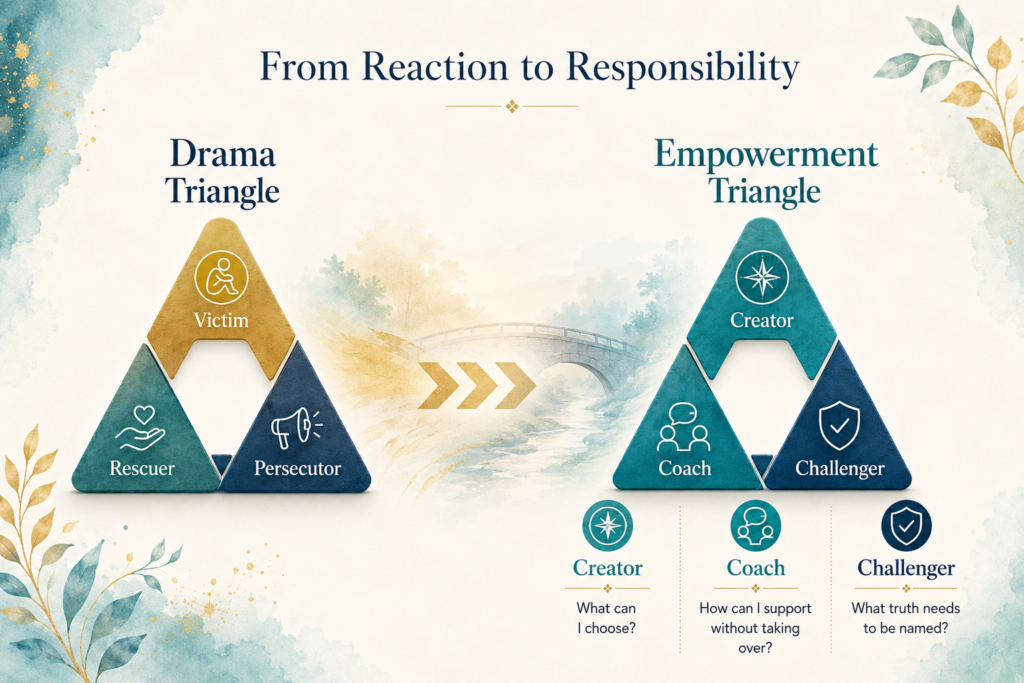
The alternative to the Drama Triangle is often described through three more empowered roles:
Creator.
Coach.
Challenger.
These roles help us shift from reactivity into responsibility.
The Victim becomes the Creator. Instead of “I have no power,” the Creator asks:
“What can I choose?”
“What is within my control?”
“What do I want to create from here?”
“What is my next useful step?”
The Creator does not deny difficulty. This is not fake positivity dressed up in a motivational quote and sent out to annoy people. The Creator simply refuses to hand over all power to the problem. The Creator says, “This may be hard, but I still have choices.”
The Rescuer becomes the Coach. Instead of “I must fix this,” the Coach asks:
“What support is actually helpful here?”
“What belongs to me, and what belongs to them?”
“What question could help them access their own wisdom?”
“How can I support without taking over?”
The Coach does not abandon people. The Coach does not become cold or detached. The Coach offers support in a way that respects the other person’s agency. This is a huge shift. It means moving from fixing people to strengthening people.
The Persecutor becomes the Challenger. Instead of “It’s your fault,” the Challenger says:
“What needs to be faced?”
“What truth needs to be named?”
“What boundary is required?”
“What standard matters here?”
The Challenger is not cruel. The Challenger does not shame, attack, or belittle. The Challenger brings honesty, clarity, and accountability. A healthy challenge can be deeply respectful. It says, “I believe you are capable of more than this, and I am willing to tell the truth.”
From drama to empowerment
The shift from the Drama Triangle to the Empowerment Triangle is not always dramatic. Often, it begins with one better question.
When you notice yourself in the Victim role, you might ask:
“What is one thing I can influence?”
When you notice yourself in the Rescuer role, you might ask:
“Am I helping, or am I taking over?”
When you notice yourself in the Persecutor role, you might ask:
“What am I feeling underneath this blame?”
These questions create a pause. And a pause is powerful. A pause gives you a chance to choose a different role before the old pattern takes the wheel and drives you straight into the emotional ditch.
When you are unsure how to respond, values clarification can help you choose a response that reflects who you want to be, rather than reacting from fear or frustration.
A practical example
Imagine someone you care about keeps making poor financial decisions and then comes to you in a panic. Your first response may be Rescuer:
“I’ll lend you the money. I’ll fix it. I’ll sort it out.”
Then, when it happens again, you may become the Victim:
“I can’t believe I’m dealing with this again. Why does everyone rely on me?”
Then you may become the Persecutor:
“You’re irresponsible. You never learn.”
The Empowerment Triangle offers another way.
As Creator, you ask:
“What kind of relationship do I want to create here? What kind of person do I want to be in this situation?”
As Coach, you might say:
“I care about you, and I’m willing to talk through your options, but I’m not going to take responsibility for solving this for you.”
As Challenger, you might add:
“This pattern is not working. I need to be honest about that.”
That response is not passive. It is not harsh. It is not rescuing. It is mature, boundaried, and clear. Will the other person love it? Perhaps not. But emotional maturity is not measured by whether everyone applauds your boundaries. Sometimes growth sounds less like thunder and more like a calm sentence you do not over-explain.
How to recognise your usual role
Most of us have a role we visit more often.
You might lean toward the Victim role when you feel overwhelmed. You may collapse inward, tell yourself nothing will change, and wait for someone or something to make it better.
You might lean toward the Rescuer role when you feel anxious. You may over-help, over-give, over-function, and call it love, responsibility, or being “the capable one.”
You might lean toward the Persecutor role when you feel out of control. You may criticise, blame, become impatient, or focus entirely on what others are doing wrong.
This is not about shame. Shame keeps us stuck. Curiosity helps us change.
The question is not, “What is wrong with me?” The better question is, “What role do I step into when I feel unsafe, uncertain, or emotionally uncomfortable?” That question opens the door to real self-awareness.
Noticing your role in the Drama Triangle is not an invitation to shame yourself; this is where self-compassion as a coaching tool becomes especially useful.
A reflection exercise: Step out of the triangle
Think of a recent situation where you felt reactive, resentful, powerless, overly responsible, or blaming. Write a few lines about what happened.
Then ask yourself:
Which role did I step into?
Victim: Did I tell myself I had no power?
Rescuer: Did I take responsibility for something that was not mine to carry?
Persecutor: Did I move into blame, criticism, or control?
Next, ask:
What would the empowered version look like?
Creator: What choice, value, or next step is available to me?
Coach: How can I support without taking over?
Challenger: What truth or boundary needs to be named respectfully?
You do not need to get this perfect. The aim is not to become a permanently calm, emotionally flawless person who floats through life like a well-regulated cloud. The aim is to notice sooner. Because when you notice sooner, you can choose sooner.
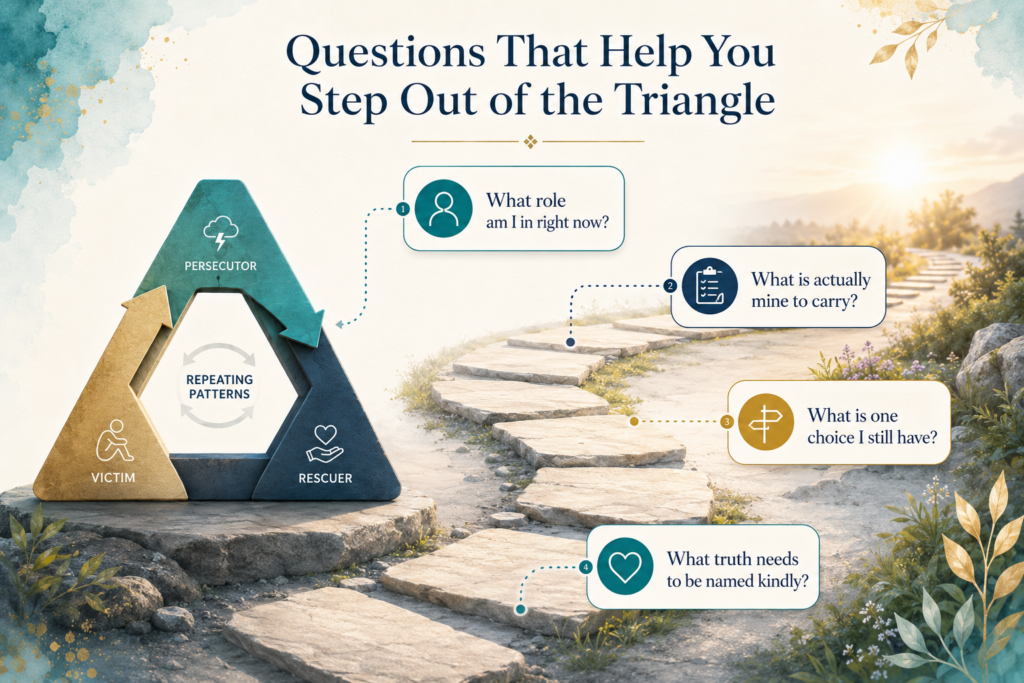
The real goal is responsibility without blame
The Drama Triangle keeps us locked in blame, helplessness, and over-responsibility. The Empowerment Triangle invites us back into agency.
That does not mean everything is your fault. It does not mean other people’s behaviour does not matter. It does not mean you should tolerate poor treatment, pretend harm did not happen, or turn every painful situation into a personal growth project with scented candles.
Some things are genuinely wrong. Some boundaries are necessary. Some relationships are not safe or healthy. But within many everyday situations, we have more power than the Drama Triangle allows us to see.
We can choose our role. We can stop fixing what is not ours. We can tell the truth without attacking. We can support others without rescuing them. We can acknowledge pain without surrendering all agency. We can take responsibility for our next step, even when the whole path is not clear.
That is emotional maturity. Not perfection. Not passivity. Not pretending everything is fine. Just the steady practice of stepping out of drama and back into choice.
A note on the model:
The Drama Triangle is commonly attributed to Stephen Karpman, who introduced the model in the 1960s. The empowered roles of Creator, Coach, and Challenger are associated with David Emerald’s work on The Empowerment Dynamic. In this article, I have used both ideas as practical self-awareness tools for everyday personal development.
This is one of several practical tools you can use to coach yourself through change. Visit my complete guide to self-coaching to explore the process and find the model that best suits what you are working through.
Want support with this?
If you recognise yourself in one of these patterns, you are not broken. You are human. Most of us learned our roles honestly. We learned them in families, workplaces, relationships, childhood dynamics, stressful seasons, and situations where we were trying to cope. But what helped you cope at one point may not be helping you grow now.
Coaching can help you notice the patterns you keep repeating, understand what they are costing you, and practise more empowered ways of responding. If you would like support with this kind of self-awareness and practical change, you are welcome to reach out about coaching.
If the idea of learning how to coach yourself with practical tools and support appeals to you, add your name to the Self-Coaching Studio interest list and I’ll keep you updated as it develops.
You do not need to live inside the same old triangle. There are other shapes available.

Megan Ruffino is a professional life coach, Master NLP Practitioner and trainer who writes about happiness, self-coaching and personal growth. She helps people understand themselves more clearly, make conscious choices and take practical steps toward lives that feel happier and more empowered.