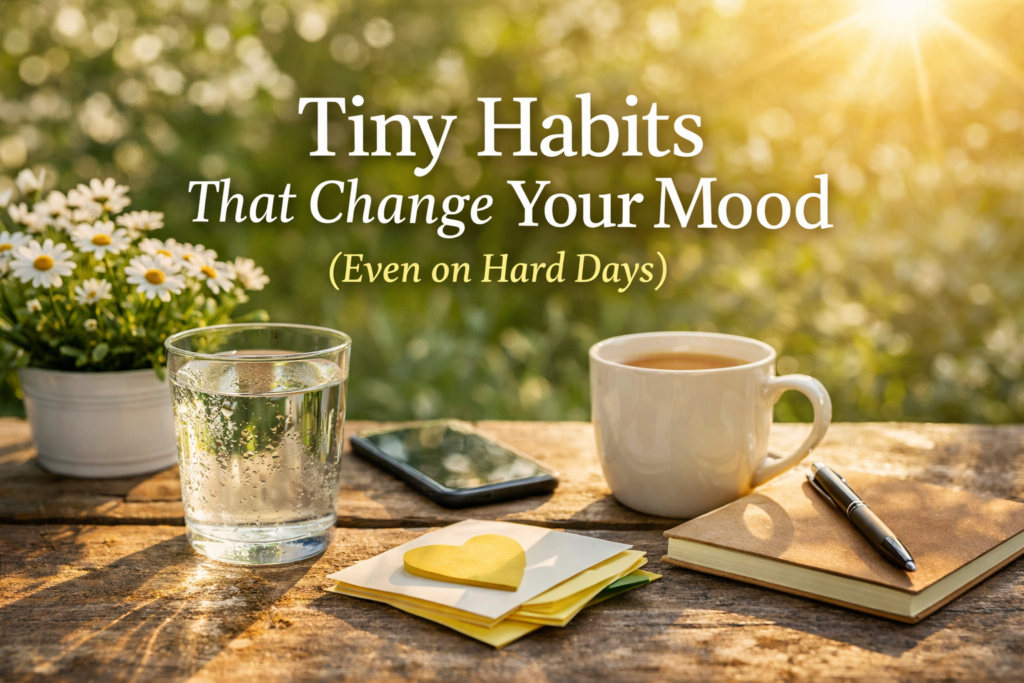
(Even on Hard Days)
We tend to think that changing how we feel requires something big.
A day off.
A breakthrough.
A complete reset.
But most of the time, it doesn’t.
More often than not, your mood shifts through small, almost unnoticeable actions — repeated quietly, consistently, without fanfare.
Not because they are dramatic.
But because they are reliable.
When life feels heavy, it’s not intensity that helps.
It’s steadiness.
And steadiness is built through small habits.
Why Tiny Habits Work
When your mood is low, your capacity is low too.
That’s the part people ignore.
You don’t need a better plan.
You need something you’ll actually do in the state you’re in.
Tiny habits work because they:
- Don’t require motivation
- Don’t rely on willpower
- Can be done even when you feel flat, tired, or overwhelmed
They meet you where you are.
And that’s what makes them powerful.
7 Tiny Habits That Can Shift Your Mood
These are not life-changing on their own. But done consistently, they change the tone of your day.
1. Step Outside for Two Minutes
No phone. No agenda. Just step outside and let your eyes adjust to natural light.
It sounds almost too simple — but exposure to daylight can quickly influence your mood and energy levels.
Even two minutes helps.

2. Drink a Glass of Water Before Coffee
Before the caffeine hits your system, give your body something it actually needs.
Hydration affects everything — including your mood, focus, and energy.
This is one of those habits that feels small but pays off quietly over time.
3. Name What You’re Feeling
Instead of saying “I feel off,” get specific.
“I feel anxious.”
“I feel flat.”
“I feel frustrated.”
Putting language to emotion helps your brain process it rather than carry it around all day.

4. Make One Small Area Tidy
Not the whole house. Just one surface.
A bench. A desk. A bedside table.
Order in your environment creates a subtle sense of control — and that alone can lift your mood.
5. Take Five Slow Breaths
Not while scrolling. Not while multitasking.
Just pause.
Inhale slowly.
Exhale slowly.
This is one of the quickest ways to calm your nervous system — and it costs you nothing.
6. Send One Genuine Message
A quick “thinking of you” text.
A thank you.
A kind word.
Connection shifts your internal state faster than isolation ever will.
And it doesn’t need to be deep or long to matter.

7. Do One Thing You Said You Would Do
Just one.
Not the whole list.
Keeping a small promise to yourself builds self-trust — and that trust changes how you feel about yourself and your day.
The Real Shift Isn’t the Habit
Here’s the part worth understanding.
These habits don’t work because they’re impressive.
They work because they interrupt the spiral.
They give your mind and body a different signal.
“I’m here.”
“I’m paying attention.”
“I’m taking care of myself, even a little.”
That message adds up.
Start Smaller Than You Think You Need To
If you’re reading this and thinking,
“I should do all of these,” don’t. Pick one.
Make it so easy you can’t talk yourself out of it.
Do it daily — especially on the days you don’t feel like it.
That’s where the shift happens.
A Final Thought
You don’t need to overhaul your life to feel better.
You need a few steady anchors throughout your day.
Small things. Done often.
Because in the end, it’s not the big moments that shape your life.
It’s the quiet ones you repeat.
Related Posts
If this resonated, you might also find these other recent posts helpful:
- The Power of a Simple Morning Ritual
- The 10-Minute Rule: How to Start When You Don’t Feel Like It
- Why Consistency Beats Motivation Every Time
- Stop Waiting to Feel Ready
External Resource
If you’d like to explore the science behind this approach, this is a solid, practical read:
Tiny Habits by BJ Fogg — a well-regarded framework for building behaviour change in a realistic, sustainable way.
(This is an affiliate link. If you choose to purchase, I may earn a small commission at no extra cost to you.)