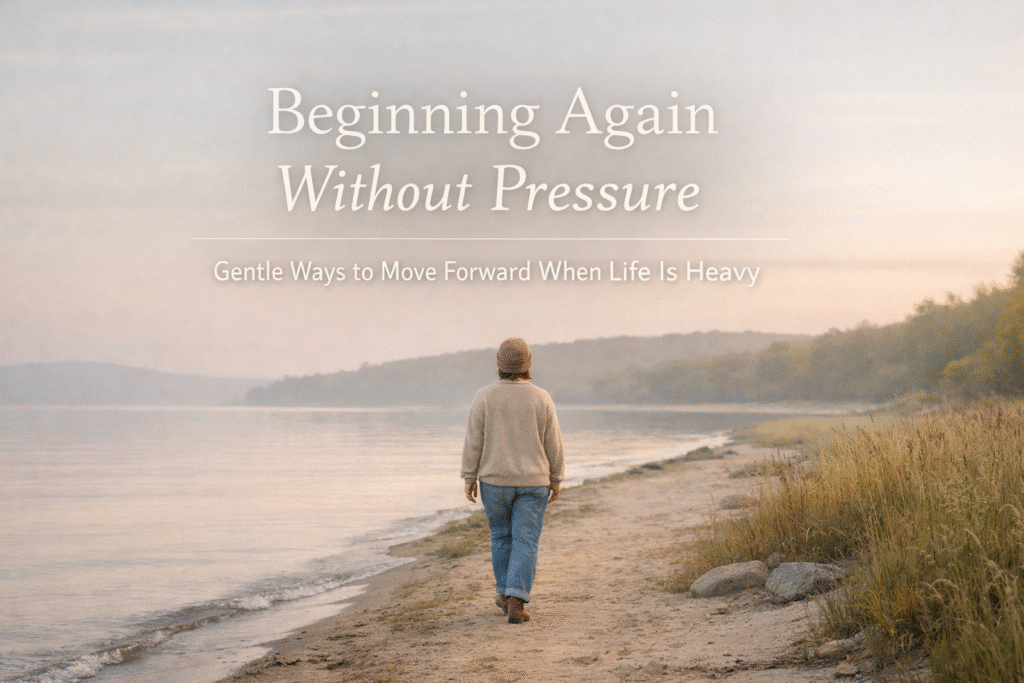
When life has been heavy for a while, the idea of beginning again without pressure can feel strangely complicated.
You might want things to change — but not want the effort, the expectation, or the risk of getting it wrong. You may feel ready for something, but unsure what that something is.
This tension is more common than we admit.
As I shared in When life knocks you off balance, the early work after upheaval isn’t about fixing or striving—it’s about finding enough stability to stand on again.
Why pressure makes starting harder
We often assume that forward movement requires a decision, a plan, or a burst of motivation. But when energy is low and the nervous system is still recovering, pressure can feel like another demand to meet — not an invitation.
This is especially true when motivation has been low for a while. As explored in Why motivation disappears when life gets hard, pressure often increases resistance rather than restoring momentum.
Pressure narrows options. It turns small steps into tests. And it makes hesitation look like failure.
In reality, starting again doesn’t need intensity.
It needs permission.
Gentle movement is still a way of beginning again
Beginning again doesn’t mean leaping into action or reinventing your life. It often looks far quieter than that.
It might be:
- revisiting one small habit that once helped
- letting go of something that no longer fits
- choosing rest without justifying it
- making space for what feels supportive now
These aren’t signs of stagnation. They’re signs of attunement.
When life has been heavy, responsiveness matters more than resolve.
Let your capacity lead
Letting capacity guide you also means accepting that “normal” may look different now. I explored this shift more deeply in The myth of getting back to normal.
Prolonged stress affects energy, confidence, and decision-making, which is why gentle pacing often supports recovery. Australian mental health organisation Beyond Blue explains how stress affects mental wellbeing.
One of the most compassionate shifts you can make is allowing your current capacity to set the pace.
Capacity isn’t fixed. It expands and contracts depending on stress, support, health, and circumstance. Ignoring it doesn’t make you stronger — it usually makes things harder.
Letting capacity lead means:
- choosing what’s manageable over what’s impressive
- adjusting expectations without self-judgement
- trusting that steadiness builds momentum over time
This isn’t about settling. It’s about sustainability.
Forward doesn’t have to mean faster
There’s a quiet belief that if we’re not accelerating, we’re falling behind. But after difficult seasons, moving slowly can be a form of wisdom.
Slow movement allows integration. It gives you space to notice what’s working and what isn’t. It helps you rebuild trust with yourself — which is often the most important foundation of all.
Often, it’s the anchors you’ve already put in place that make gentle forward movement possible. I explored this idea further in Anchors, not goals, where stability—not speed—takes priority.
Forward can mean deeper, not faster.
You don’t need to be certain to begin
Many people wait for clarity before they move. They want to feel confident, motivated, or sure.
But clarity often follows action — not the other way around. Gentle action, taken without pressure, can reveal what the next step actually is.
You don’t need a five-year plan.
You don’t need to feel ready.
You just need one small, kind step that respects where you are now.
A quieter kind of beginning
Beginning again isn’t a dramatic moment. It’s rarely an announcement or a turning point you can point to later.
More often, it’s a series of small choices made with care instead of force.
If life has been heavy, you’re allowed to move forward gently. You’re allowed to take your time. And you’re allowed to build a life that fits who you are now — not who you were before everything changed.
That kind of beginning tends to last.

Megan Ruffino is a professional life coach, Master NLP Practitioner and trainer who writes about happiness, self-coaching and personal growth. She helps people understand themselves more clearly, make conscious choices and take practical steps toward lives that feel happier and more empowered.