
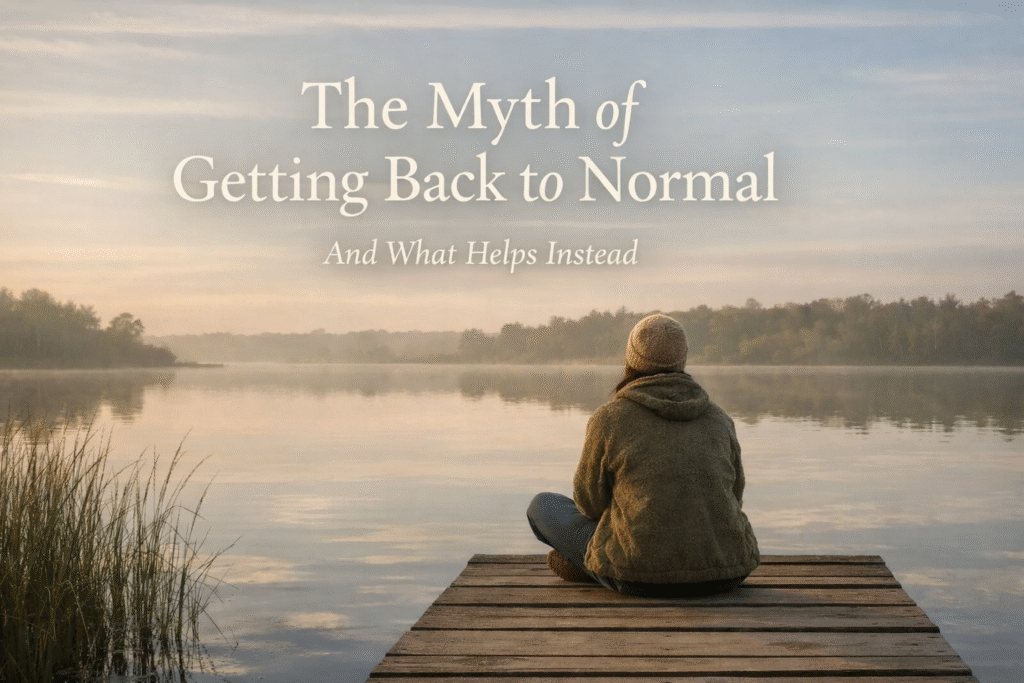
After a difficult season, many of us set a quiet goal for ourselves: getting back to normal after life changes.
We think, I just want things to feel normal again.
It sounds reasonable. Comforting, even. But for many people, this idea becomes an invisible source of frustration — because no matter how hard they try, “normal” doesn’t quite arrive.
And that’s not because they’re failing.
It’s because something has changed.
As I explored in When life knocks you off balance, disruption often leaves us searching for stability before we even realise how deeply we’ve been affected. That search can quietly turn into pressure to return to who we were before.
Why trying to get back to normal keeps us stuck
When life disrupts us — through loss, stress, illness, uncertainty, or prolonged strain — it doesn’t just interrupt our routines. It reshapes us.
Our nervous system learns new thresholds. Our priorities subtly shift. Our tolerance for pressure often changes. Yet we keep measuring ourselves against who we were before.
The problem isn’t that you’re different now.
The problem is expecting yourself not to be.
The hidden cost of chasing your old self
Prolonged stress changes how we think, feel, and cope over time, which is why adjusting expectations after upheaval is often part of recovery. Australian mental health organisation Beyond Blue explains how stress affects mental wellbeing.
Trying to return to a previous version of yourself can create constant low-grade tension. You might notice thoughts like:
- I should be able to handle this by now
- I used to be more motivated than this
- Why can’t I get back into my old rhythm?
These comparisons quietly drain energy. They turn recovery into a performance and adjustment into a failure.
This constant self-comparison also helps explain why motivation often disappears during difficult periods. As I shared in Why motivation disappears when life gets hard, low motivation is usually a stress response—not a personal failure.
What often gets missed is this:
your system may no longer be designed for the pace, pressure, or expectations you once carried — and that isn’t a flaw.
A more realistic question to ask
Instead of asking, How do I get back to normal?
Try asking, What feels sustainable for me now?
That question shifts the focus from restoration to orientation. From reclaiming the past to building something that actually fits your present reality.
This doesn’t mean giving up on growth or ambition. It means letting your current capacity lead, rather than dragging it behind an outdated standard.
Normal isn’t something you return to — it’s something you renegotiate
Renegotiating normal often means adjusting pace as much as expectations. Slowing down, choosing fewer commitments, and letting life move at a more human speed can be deeply stabilising. I explore this further in The joy of slow living in a fast world.
Every significant experience leaves a mark. The work isn’t to erase it, but to integrate it.
Often, what helps most is allowing a new kind of “normal” to emerge:
- a different pace
- clearer boundaries
- more selective commitments
- greater respect for your energy
This kind of normal may look quieter from the outside — but it’s often far more stable on the inside.
What actually helps instead
For many people, grounding practices play a quiet but important role in this adjustment. Even simple time outdoors can help regulate stress and restore perspective, something I explored in Nature, the original antidepressant.
Letting go of the old normal doesn’t require dramatic change. It usually starts with small, honest adjustments:
- noticing what drains you faster than it used to
- acknowledging what you no longer want to tolerate
- choosing steadiness over speed
These choices aren’t signs of shrinking. They’re signs of self-awareness.
You haven’t fallen behind — you’ve moved through something
If “getting back to normal” feels impossible, it may be because you’re not meant to go back. You’re meant to go forward differently.
There is nothing wrong with you for needing a new rhythm.
There is wisdom in listening to what this season is asking of you.
In the next post, we’ll explore what actually helps create stability during times of change — not goals or grand plans, but simple anchors that make life feel more manageable again.

Megan Ruffino is a professional life coach, Master NLP Practitioner and trainer who writes about happiness, self-coaching and personal growth. She helps people understand themselves more clearly, make conscious choices and take practical steps toward lives that feel happier and more empowered.