
Have you ever felt stuck, but not because you did not know what to do?
You may have had options. You may have had advice. You may even have had a perfectly sensible pros-and-cons list sitting in front of you, behaving itself beautifully and still not helping one bit.
That is often because the real problem is not lack of information. It is lack of alignment.
Values clarification is a simple but powerful coaching model that helps you work out what actually matters to you, what you are currently prioritising, and where your choices may have drifted away from the kind of life you want to live.
This matters because many people are not stuck because they are lazy, undisciplined, unmotivated, or hopelessly disorganised. Sometimes they are stuck because they are living according to someone else’s expectations, old habits, fear, guilt, approval-seeking, or the loud demands of everyday life.
And that will wear a person down.
What Is Values Clarification?
Values clarification is the process of identifying the principles, qualities, and priorities that matter most to you.
Your values are not the same as your goals. A goal is something you can achieve or complete. A value is more like a direction. It is something you keep living by.
For example, “buying a house” is a goal. “Security” may be the value underneath it. “Starting a business” is a goal. “Freedom,” “creativity,” or “contribution” may be the values driving it. “Getting fitter” is a goal. “Health,” “self-respect,” or “energy” may be the values beneath it.
Values are the deeper reasons behind your choices.
When you are clear on your values, decision-making becomes easier. Not always easy, mind you. Let’s not get carried away. Life still has bills, awkward conversations, family obligations, and the occasional plumbing disaster. But your decisions become less random. You have something to measure them against.
Instead of asking, “What should I do?” you can begin asking, “What choice best reflects who I want to be and what matters most to me?”
That is a much better question.
Why Values Matter for Happiness
Happiness is not just about feeling good all the time. That would be lovely, but it is also not how human life works.
A deeper form of happiness comes from living in a way that feels meaningful, honest, and connected to what matters. When your outer life does not match your inner values, you may still be functioning, but something in you starts to feel restless.
You might feel resentful without knowing why. You might keep saying yes when you mean no. You might achieve things that look impressive from the outside but feel strangely empty on the inside. You might feel tired in a way that sleep does not fully fix.
That is often a sign that your values are being ignored.
This connects closely with the idea behind the Think, Feel, Act model: what we believe, think, and focus on shapes how we feel and behave. Values clarification takes that a step deeper by asking, “What am I organising my life around in the first place?”
Because here is the uncomfortable bit: we are always living by values. The question is whether they are conscious values or unconscious ones.
You might say you value health, but your current choices may show that convenience is winning. You might say you value peace, but your calendar may show that obligation is running the show. You might say you value freedom, but your habits may reveal that approval is still sitting in the driver’s seat wearing a cheap disguise.
No shame. We all do this. The point is not to beat yourself up. The point is to wake up.
Values Versus Priorities
One of the most useful parts of this model is that it helps you notice the difference between what you value and what you are currently prioritising.
You may genuinely value family, health, creativity, learning, faith, honesty, stability, adventure, kindness, independence, or contribution.
But your actual life may be prioritising urgency, people-pleasing, comfort, avoidance, image, fear, or keeping the peace.
That gap can create a lot of emotional noise.
For example, someone may deeply value health but constantly prioritise work, exhaustion, and convenience. Someone else may value honesty but keep avoiding difficult conversations because they fear conflict. Another person may value growth but keep choosing the familiar because change feels risky.
This does not mean they do not really value those things. It means their values have been outranked by something else.
That “something else” is worth getting curious about.
Where Are You Betraying Yourself?
This is where values clarification can become gently confronting.
Self-betrayal often does not arrive with dramatic music and a villain cape. It usually shows up quietly.
- It sounds like, “I’ll just do it to keep everyone happy.”
- It sounds like, “It’s easier if I don’t say anything.”
- It sounds like, “I know this is not what I want, but I don’t want to disappoint anyone.”
- It sounds like, “I’ll get back to myself later.”
And later keeps moving.
When you repeatedly choose against your values, you may start to feel disconnected from yourself. You may feel irritated, flat, resentful, or strangely invisible in your own life.
That is not because you are failing. It may simply be information.
Your discomfort may be trying to tell you that something important is being neglected.
This is also why values clarification works beautifully alongside tools such as the Wheel of Life. The Wheel of Life helps you see which areas of your life need attention. Values clarification helps you understand what kind of attention they need and why. Internal link suggestion: link here to your Wheel of Life article.
A Simple Values Clarification Exercise
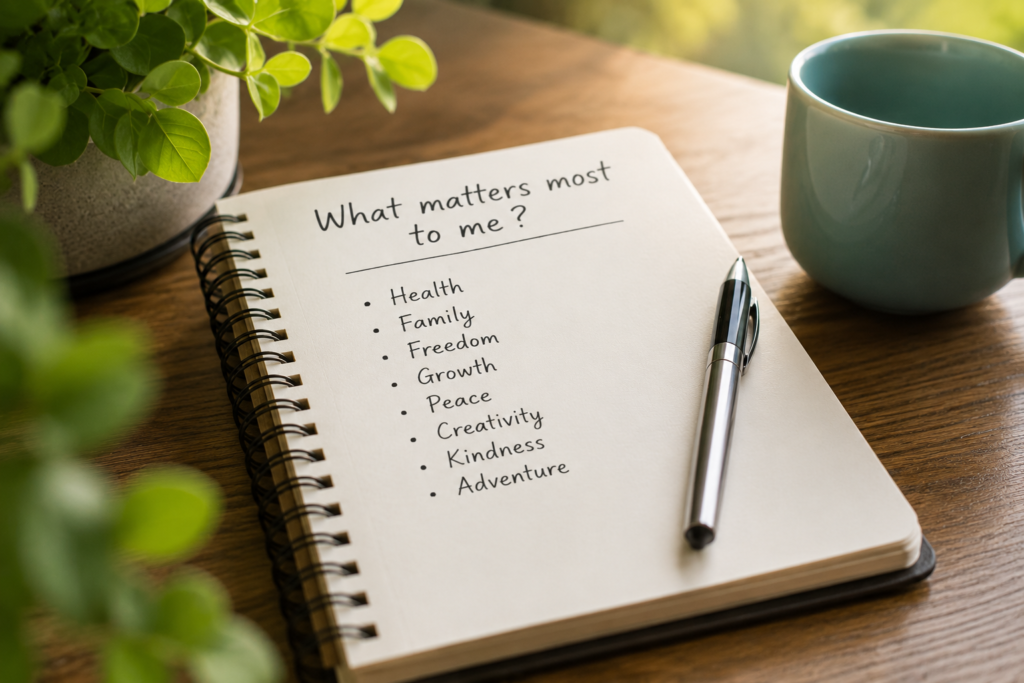
You do not need a complicated worksheet to begin. A notebook and a bit of honesty will do.
If you would like a more structured exercise, PositivePsychology.com also has a useful overview of values clarification activities and worksheets.
Start by asking yourself: What matters most to me at this stage of my life?
Do not answer with what should matter. That is where things go sideways. Answer with what genuinely matters.
You might write words such as health, peace, family, freedom, courage, honesty, learning, stability, creativity, service, faith, fun, security, adventure, kindness, self-respect, contribution, or connection.
Once you have a list, choose your top five. Not twenty-five. Five. This is where the model gets useful, because everything cannot be equally important at the same time. That is how people end up exhausted, overcommitted, and muttering dark things at their calendar.
Then ask yourself:
- Which of these values am I actually living by at the moment?
- Which ones are being neglected?
- Where does my calendar reflect these values?
- Where does my spending reflect these values?
- Where do my relationships reflect these values?
- Where am I saying yes when my values are asking me to say no?
- Where am I choosing fear, guilt, approval, or habit instead of what matters?
These are not questions to rush. Sit with them. Let them be a little inconvenient. Good questions often are.
An Example of Values Clarification in Real Life
Imagine someone who says they value peace, health, and family.
On paper, that sounds clear. But when they look at their actual life, they realise they are working late most nights, saying yes to things they resent, scrolling instead of resting, and snapping at the people they love because they are stretched too thin.
Their stated values are peace, health, and family.
Their current priorities are obligation, avoidance, and keeping up.
Again, this is not a moral failure. It is a pattern.
Values clarification helps this person stop saying, “I just need to be more disciplined,” and start asking, “What would it look like to organise my life around peace, health, and family in small, practical ways?”
That might mean leaving work on time two nights a week. It might mean having one honest conversation. It might mean making dinner simpler. It might mean going to bed earlier instead of pretending late-night scrolling is “me time.” We have all tried to sell ourselves that little fantasy. It rarely delivers.
The point is not to overhaul your entire life by Tuesday. The point is to make one choice that brings you back into alignment.
Values Make Decisions Clearer

One of the best uses of values clarification is decision-making.
When you do not know what matters most, every option can look equally confusing. You can get trapped in overthinking, second-guessing, and outsourcing your judgement to everyone else.
But when your values are clear, you can use them as a filter.
- If you value health, does this choice support or undermine it?
- If you value freedom, does this choice create more freedom or less?
- If you value honesty, what truth are you avoiding?
- If you value family, are you acting from love or from guilt?
- If you value growth, are you choosing what is familiar or what is right?
This does not mean you will always choose perfectly. Nobody does. But you will be less likely to drift.
The GROW model is useful here too, because once you know your values, you can use them to set clearer goals and identify better options.
Values tell you the direction. Goals give you the steps.
Values Are Not Meant to Impress Other People
This is important.
Your values do not need to sound noble enough to put on a motivational poster.
Some people genuinely value adventure. Others value stability. Some value achievement. Others value simplicity. Some value independence. Others value belonging. Some value creativity. Others value order.
None of these are automatically better than the others.
The problem begins when you pretend to value something because it sounds good, looks good, or keeps other people comfortable.
You may think you should value ambition, when what you really crave is peace. You may think you should value constant availability, when what you really need is space. You may think you should value being agreeable, when what you actually value is honesty.
This is where values clarification can feel like taking off a pair of shoes that never quite fit.
You are not trying to become someone else. You are trying to live more truthfully as yourself.
The Self-Coaching Question That Changes Everything
Here is a simple question you can use whenever you feel stuck:
What value am I being asked to honour here?
That one question can cut through a lot of noise.
- If you are avoiding a conversation, the value may be honesty.
- If you are exhausted and resentful, the value may be self-respect or rest.
- If you are bored and restless, the value may be growth or adventure.
- If you are overwhelmed by clutter, the value may be simplicity or order.
- If you are constantly trying to keep everyone happy, the value may be peace, but the method may be people-pleasing. And those are not the same thing.
That distinction matters.
Sometimes we try to protect a value in a way that actually violates it. We avoid conflict in the name of peace, but end up resentful and tense. We overwork in the name of security, but damage our health. We say yes in the name of kindness, but become dishonest about our limits.
Values clarification helps us choose cleaner, more honest ways to live what matters.
A Practical Values Check-In
Try this as a weekly self-coaching practice.
Choose one value that matters to you right now. Write it at the top of a page.
Then answer these four questions:
- How did I honour this value this week?
- Where did I move away from it?
- What got in the way?
- What is one small choice I can make this week to live this value more clearly?
Keep it simple. A value does not need a grand gesture. In fact, most values are lived in ordinary, unglamorous moments.
- Health may look like drinking water and going for a walk.
- Courage may look like sending the email.
- Peace may look like leaving your phone in another room.
- Connection may look like asking a better question.
- Self-respect may look like not explaining yourself for the seventeenth time to someone committed to misunderstanding you.
Small choices count. They are the bricks. A life is built brick by brick, not by one dramatic renovation montage.
Final Thoughts
Values clarification is not about creating a perfect life.
It is about creating a more honest one.
When you know what matters most, you can make decisions with more steadiness. You can see where you are out of alignment. You can stop blaming yourself for lacking discipline when the deeper issue may be that your life is being pulled in a direction that does not fit you anymore.
Your values give you a way back to yourself.
They remind you that happiness is not just about chasing pleasant feelings. It is about living with meaning, integrity, and self-respect.
So if you feel stuck, do not only ask, “What do I need to do?”
Ask, “What matters here?”
Then ask, “What would it look like to honour that today?”
Start there.
That is often where the next right step becomes clear.
This is one of several practical tools you can use to coach yourself through change. Visit my complete guide to self-coaching to explore the process and find the model that best suits what you are working through.
If the idea of learning how to coach yourself with practical tools and support appeals to you, add your name to the Self-Coaching Studio interest list and I’ll keep you updated as it develops.
Need Help Getting Clear on What Matters Most?
Sometimes it is hard to see your own patterns clearly when you are standing in the middle of them.
If you are feeling stuck, torn between choices, or aware that the life you are living no longer quite fits the person you are becoming, coaching can help you slow down, sort through the noise, and reconnect with what matters most to you.
You do not need to have it all worked out before you begin. In fact, that is often the point of coaching. Together, we can look at where you are now, what you truly value, what keeps pulling you off course, and what small, honest steps would help you move forward with more clarity and confidence.
If you would like support with this, you are welcome to explore life coaching with me and take the next step when you are ready.

Megan Ruffino is a professional life coach, Master NLP Practitioner and trainer who writes about happiness, self-coaching and personal growth. She helps people understand themselves more clearly, make conscious choices and take practical steps toward lives that feel happier and more empowered.