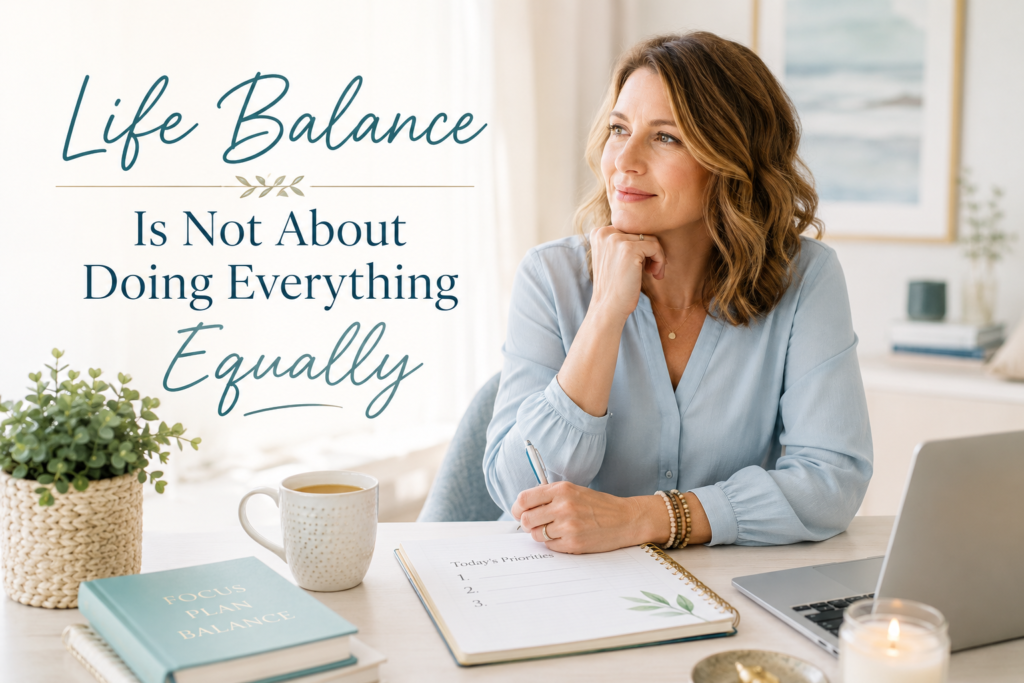
There’s a common idea in personal development that a balanced life means giving equal attention to every area of life.
Work. Health. Relationships. Money. Personal growth. Fun. Home. Purpose.
In theory, it sounds beautiful.
In real life, it becomes one more impossible standard to measure yourself against.
Because life doesn’t always ask for equal attention. Sometimes one area genuinely needs more of you. Work might demand a bigger season of focus. Your health might need to come first. Family responsibilities might take up more space. Rest, recovery, or rebuilding your confidence might have to become the priority for a while.
That doesn’t mean your life is unbalanced.
It may mean you’re responding honestly to the season you’re in.
What Is the Life Balance Model?
The Life Balance Model is a coaching tool that helps you look at how your energy, attention, time, and choices are being distributed across the important areas of your life.
It’s closely related to the Wheel of Life coaching tool, which helps you assess different areas of your life and notice where things feel strong, neglected, or out of alignment.
But the Life Balance Model adds an important layer. Instead of asking “Is everything equal?”, it asks:
“Is my life arranged in a way that supports the season I’m actually in?”
That one question changes everything, because balance isn’t about symmetry. Balance is about support.
Balance Means Support, Not Symmetry
A balanced life doesn’t mean spending the same amount of time on every area. That would be like expecting every instrument in an orchestra to play at the same volume for the entire performance. It wouldn’t create harmony — it would create noise.
In some seasons, your career may need to be louder. In others, your health may need the lead melody. At other times, your relationships, finances, home life, healing, creativity, or spiritual life may need more space.
A life can still be balanced even when one area is getting more attention — as long as that attention is intentional, sustainable, and aligned with what matters most.
The problem isn’t that one area takes more focus. The problem is when one area consumes everything else without your conscious consent.
That’s the line between a focused season and a life that’s quietly tipped over: a focused season is chosen, acknowledged, and reviewed. An unbalanced life happens by default.
Choosing to focus on study, business growth, healing, parenting, or health for a period can be wise and necessary — you know what you’re doing, you understand the trade-offs, you have some sense of how long it’s likely to last. That’s very different from looking up one day and realising your work has swallowed your health, your caring role has erased your own needs, or your responsibilities have quietly crowded out joy, rest, and connection.
The Life Balance Model helps you notice the difference. It invites you to ask whether your current arrangement is serving you, or simply running you.
A More Useful Way to Picture It
Instead of imagining life balance as a perfectly even circle, picture it as a well-loaded vehicle heading through rough country.
The load doesn’t have to be identical on every side. But it does need to be arranged well enough that you can keep moving without tipping over. Some things get packed tightly. Some things need to stay within easy reach. Some things need to be left behind for this part of the journey.
Balance isn’t about carrying everything. It’s about carrying what matters in a way that lets you keep travelling with steadiness, strength, and some measure of peace.

Questions the Life Balance Model Helps You Explore
- What season of life am I actually in right now?
- What area genuinely needs more of my attention at the moment?
- What area has been neglected for too long?
- Am I choosing this focus consciously, or have I drifted into it?
- What am I sacrificing, and is that sacrifice acceptable for this season?
- What small adjustment would create more support, steadiness, or relief?
These questions aren’t about judging yourself. They’re about telling the truth — and truth, handled kindly, is one of the most useful coaching tools there is.
Life Balance and Values
The Life Balance Model becomes even more useful when you connect it with your values — the things that matter most to you, that shape what feels meaningful, what feels draining, and what feels out of alignment.
It’s worth reading alongside Values Clarification, because sometimes what looks like a time management problem is actually a values problem. You might have enough hours in the day, but not enough time for what matters. You might be productive, but disconnected from purpose. You might be achieving, but not feeling nourished.
When your life is arranged around urgency instead of values, imbalance often follows.
Maintaining a healthy work-life balance can support wellbeing, reduce stress, and help you make more intentional choices about how your time and energy are used.
Life Balance and Goal Setting
The Life Balance Model also pairs well with tools like the GROW Model and the WOOP Method.
GROW helps you clarify your goal, current reality, options, and next steps. WOOP helps you explore your wish, desired outcome, likely obstacles, and practical plan. The Life Balance Model sits beside these because it asks a different question: does this goal actually fit my life right now?
A goal can be exciting, meaningful, and possible — and still be poorly timed. Sometimes it needs adjusting so it supports your current season rather than overwhelming it. Good coaching isn’t just about pushing forward. Sometimes it’s about arranging your life so forward movement becomes possible.
Signs Your Life May Be Out of Balance
Your life may be asking for adjustment if you notice:
- you feel constantly resentful, depleted, or stretched thin
- one area of life is repeatedly taking from every other area
- you have no space for recovery
- your health, relationships, or emotional wellbeing are quietly deteriorating
- you’re living mostly in reaction mode
- you keep saying “I just need to get through this,” but “this” never ends
- your life looks successful from the outside but feels unsustainable from the inside
These signs don’t mean you’ve failed. They mean your current system may need redesigning — and that’s something you can work with.
A Simple Life Balance Reflection Exercise
Take a few quiet minutes and write down the main areas of your life — health and wellbeing, work or business, relationships, family, money, home, personal growth, fun and recreation, spirituality or meaning, rest and recovery.
Then ask yourself:
- Which area needs the most attention this season?
- Which area has been quietly neglected?
- Which area is taking more than it’s giving?
- Which area, if strengthened even slightly, would support everything else?
- What is one small adjustment I could make this week?
Be honest without becoming harsh. You’re not trying to create a perfect life on paper — you’re trying to understand the life you’re actually living.
Balance Is Seasonal
There will be seasons of building, healing, caring, learning, simplifying, and beginning again. You don’t need to give every area of life equal attention at every moment. But you do need to keep checking whether the way your life is arranged still supports the person you’re becoming.
Not perfection. Not equal effort everywhere. Not another reason to feel behind.
Just a clearer, wiser way to ask: what needs to matter most right now — and how can I arrange my life to support that?
Take the Life Balance Audit

Want to work through this yourself first? Grab the free Life Balance Audit worksheet — a simple three-page tool to map where your attention is actually going, ask yourself the right questions, and choose one small adjustment for the week ahead.
This is one of several practical tools you can use to coach yourself through change. Visit my complete guide to self-coaching to explore the process and find the model that best suits what you are working through.
Need Help Applying This?
Sometimes it’s hard to see your own life clearly from the inside. You may know something needs to change but not know where to begin. Or you may have several competing priorities and feel unsure which one deserves your attention first.
Coaching can help you slow down, sort through the noise, clarify what matters, and create practical next steps that fit the season you’re actually in. If you’d like support applying the Life Balance Model, the Wheel of Life, the GROW Model, WOOP, Values Clarification, or any other coaching tool to your own life, you’re welcome to explore coaching with me.
You don’t have to work it all out alone.
I’m also developing The Self Coaching Studio, an upcoming membership space for people who want practical, reflective, guided self-coaching tools they can use in everyday life.
If the Self-Coaching Studio sounds like something you would like to be part of, add your name to the interest list and I will keep you updated as it comes together.

Megan Ruffino is a professional life coach, Master NLP Practitioner and trainer who writes about happiness, self-coaching and personal growth. She helps people understand themselves more clearly, make conscious choices and take practical steps toward lives that feel happier and more empowered.