Most of us have heard that we need to “get out of our comfort zone” if we want to grow.
It is usually said as though the comfort zone is a place for the weak, the lazy or the unambitious. We are encouraged to push harder, take bigger risks and stop making excuses.
There is some truth in the idea. Growth often does require us to do something unfamiliar. We may need to risk being uncomfortable, uncertain or imperfect for a while.
But the comfort zone is not the enemy.
Sometimes it is exactly where we need to be.
The Comfort Zone Model can be helpful because it shows that growth is not one dramatic leap from safety to success. It is a gradual process. We move through different stages as we build confidence, develop skills and discover what we are capable of.
Used wisely, the model can help us recognise when we are avoiding growth. It can also help us recognise when we are pushing ourselves too hard.
The aim is not to constantly force ourselves beyond our limits. It is to find the difference between a healthy stretch and self-punishment.
What Is the Comfort Zone Model?
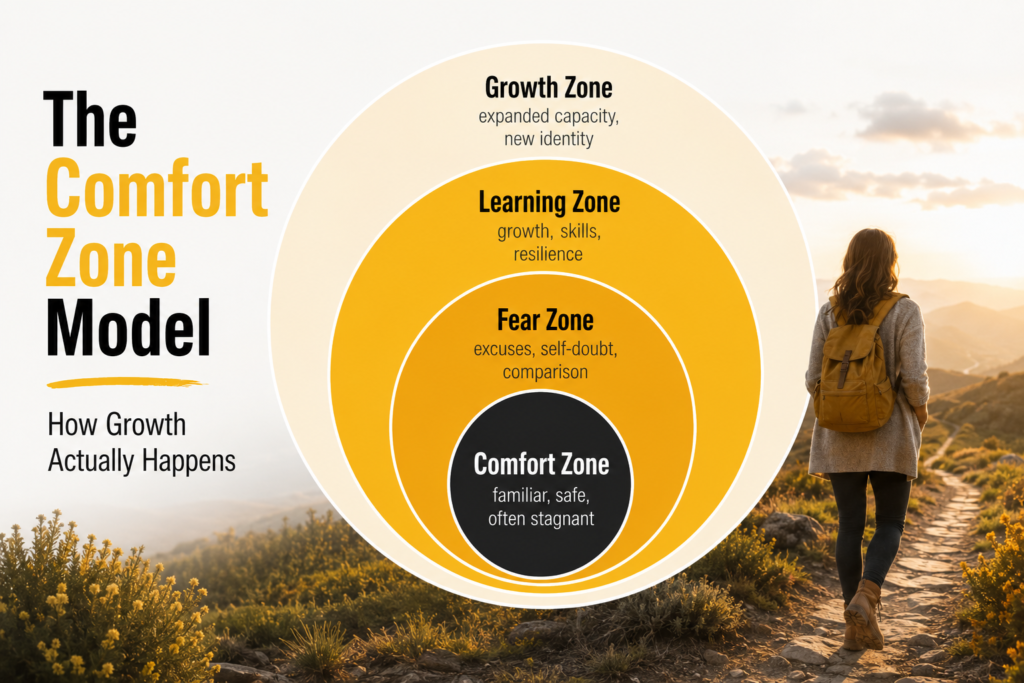
The Comfort Zone Model is usually shown as a series of circles moving outward.
At the centre is the Comfort Zone. Beyond that is the Fear Zone, followed by the Learning Zone and then the Growth Zone.
The model suggests that when we move beyond what is familiar, we often experience fear before we begin to learn. As we continue practising and adapting, our capacity expands. What once felt difficult may eventually become part of our new comfort zone.
This can apply to almost any area of life.
It might involve speaking up in a meeting, applying for a new role, joining a social group, setting a boundary or learning a new skill. It may be something visible to others, or it may be a quieter internal change, such as learning to tolerate uncertainty without immediately trying to control the outcome.
Growth does not always look impressive from the outside.
Sometimes growth is simply doing something differently from the way you have always done it.
The Comfort Zone
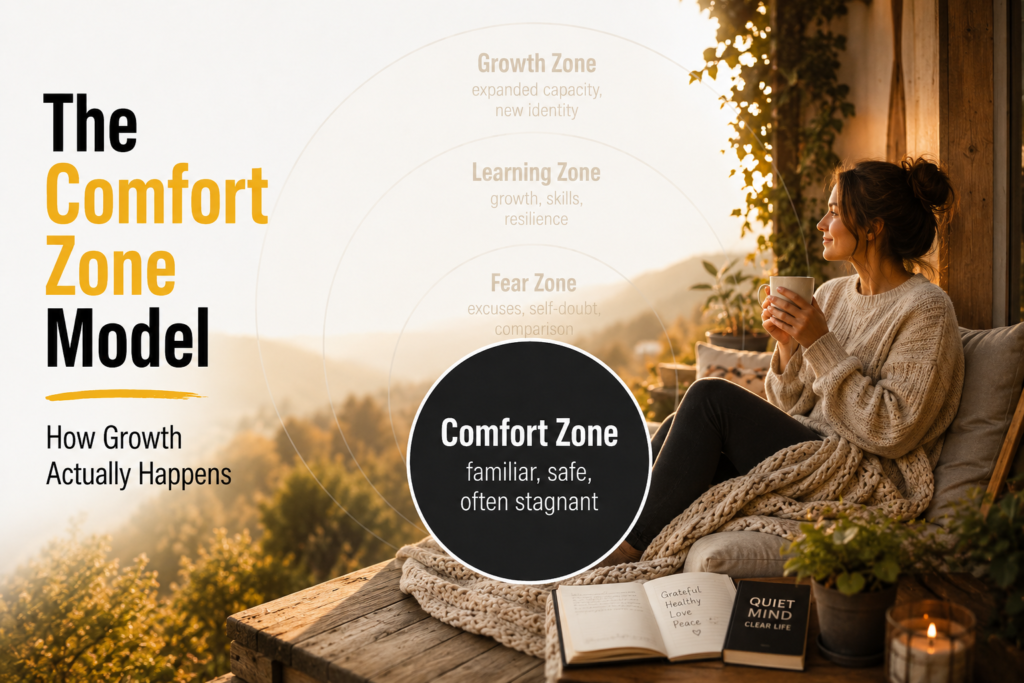
The Comfort Zone is the place where things feel familiar and manageable.
We know what is expected of us. We understand the routines. We can usually predict what will happen next.
There is nothing inherently wrong with this.
Our comfort zones give us stability. They allow us to rest, recover and function without having to think carefully about every decision we make. Familiar routines can reduce stress and give us a sense of safety.
The problem begins when comfort becomes stagnation.
We may stay in a job we dislike because looking for another one feels overwhelming. We may avoid difficult conversations because we do not want to risk conflict. We may keep telling ourselves that we will begin something “when the time is right,” even though the right time never seems to arrive.
Comfort can quietly become a cage when we stay there only because we are afraid to leave.
A useful question is not, “Am I comfortable?”
A better question is, “Is this comfort helping me recover, or helping me avoid?”
The Fear Zone
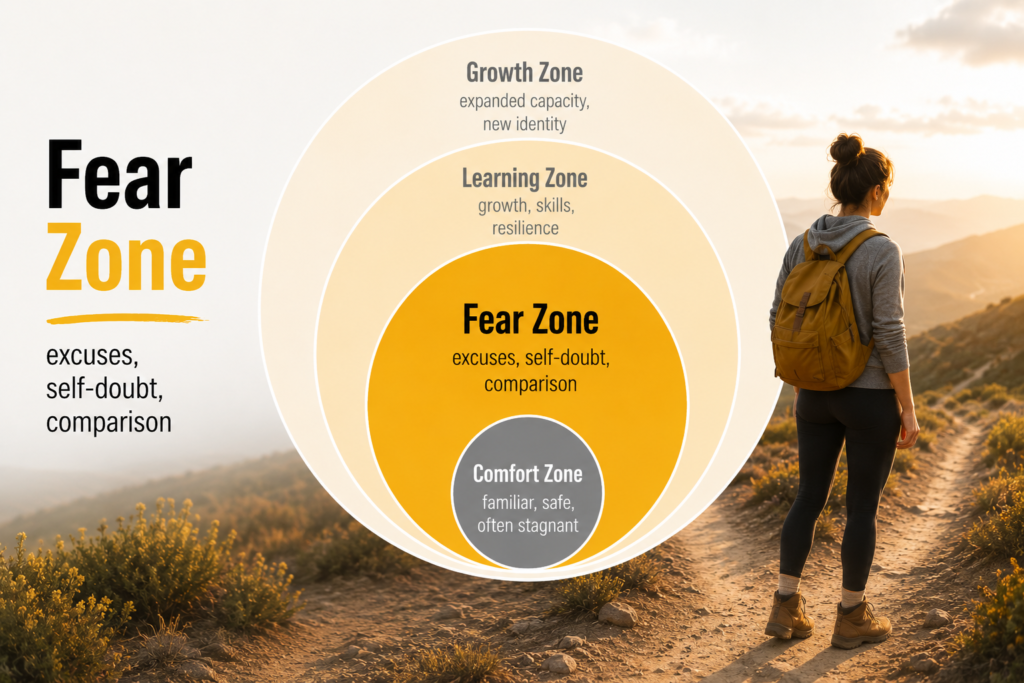
When we step beyond what is familiar, we often enter the Fear Zone.
This is where doubt becomes louder.
We may begin comparing ourselves with people who appear more capable or confident. We may worry about embarrassment, rejection or failure. We may suddenly find many convincing reasons why now is not a good time.
This does not mean the decision is wrong.
Fear is often a natural response to uncertainty. Your mind is trying to protect you from something it cannot fully predict.
The problem is that fear rarely announces itself plainly.
Instead of saying, “I am frightened that I might fail,” we may tell ourselves that we need to do more research. We may keep adjusting the plan. We may decide that we need to feel confident before we begin.
Sometimes that hesitation is also being fuelled by a limiting belief about what we are capable of or what might happen if we try.
Sometimes preparation is sensible. Sometimes it is fear wearing a sensible hat.
The Fear Zone is where many people turn back, not because they are incapable, but because they interpret discomfort as danger.
It can help to ask, “Is this actually unsafe, or is it simply unfamiliar?”
That question does not dismiss fear. It helps us understand what the fear is trying to tell us.
The Learning Zone
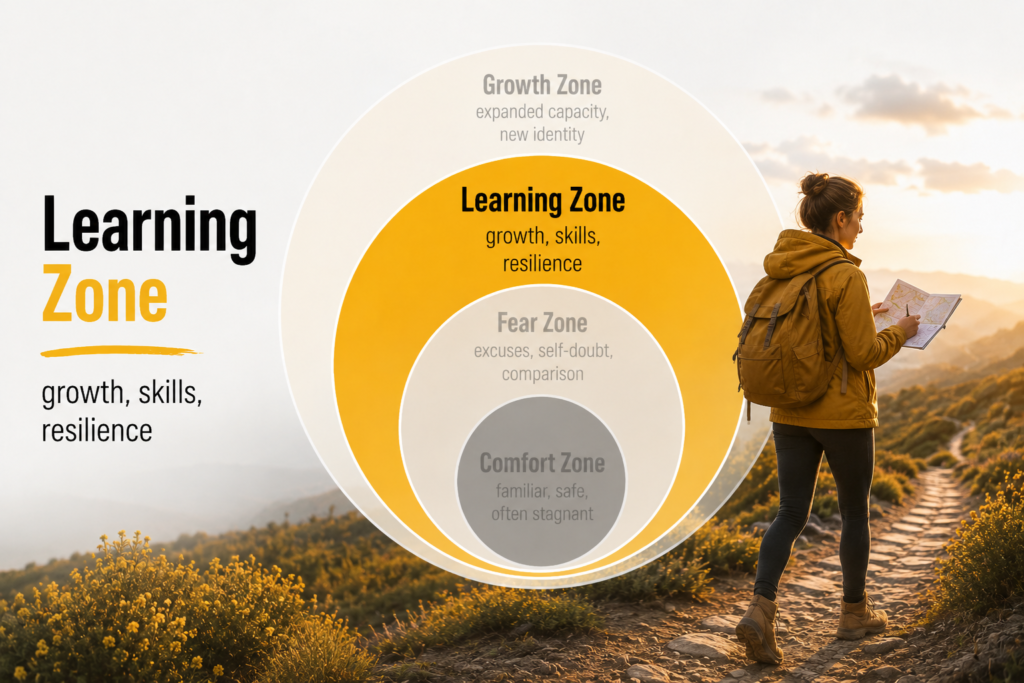
If we continue despite some discomfort, we begin to enter the Learning Zone.
This is where we practise.
We make mistakes, gather information and adjust our approach. We begin to understand what works and what does not. Learning is often clumsy.
The first attempt may be awkward. The result may not match the picture we had in our minds. We may need guidance, feedback or more time than we expected.
This stage can be frustrating because we are no longer protected by the familiarity of the Comfort Zone, but we have not yet developed the competence that makes the new experience feel easier.
We are beginners again.
That can be uncomfortable for adults who are used to being capable.
The Learning Zone asks us to tolerate imperfection. It asks us to see mistakes as information rather than evidence that we should give up.
Confidence often develops here, but usually after action rather than before it.
We do not always begin because we feel ready. Sometimes we begin, learn that we can cope and become more ready along the way.
The Growth Zone
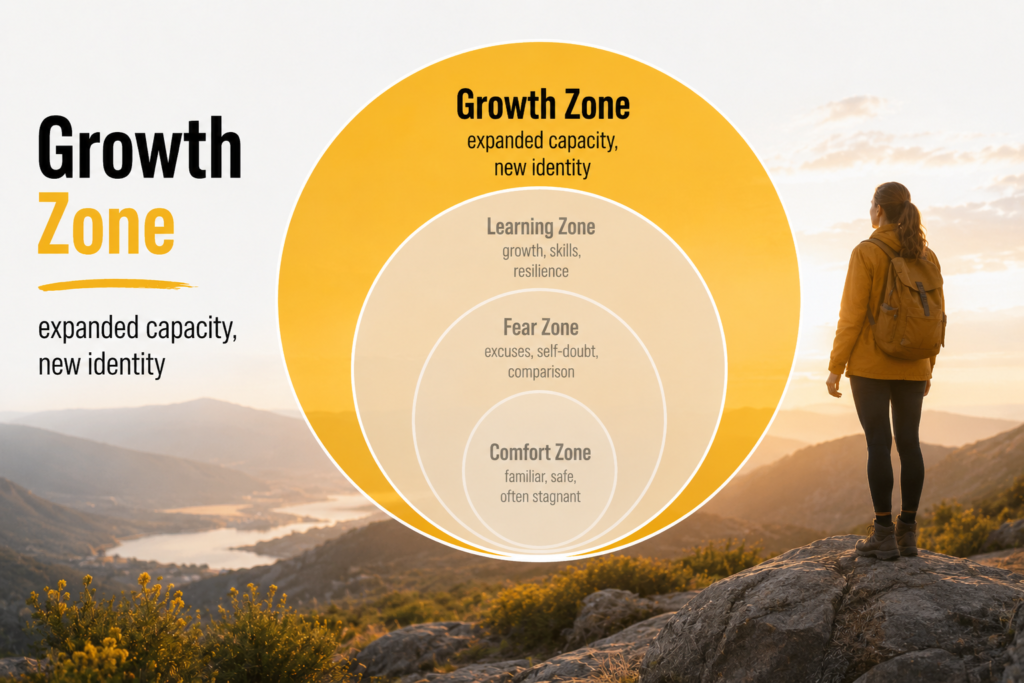
The Growth Zone is where our capacity begins to expand.
We are able to do things that once felt beyond us. We have developed greater skill, resilience or self-trust.
The change may be practical. Perhaps we can now speak in public, manage a difficult conversation or complete a task that once felt intimidating.
It may also be an identity shift.
We no longer see ourselves as someone who could never do that thing.
We become someone who can learn, adapt and cope with discomfort.
That does not mean fear disappears. It means fear has less authority.
The Growth Zone is not a permanent destination. It gradually becomes part of a larger Comfort Zone.
Then another challenge appears, and the process begins again.
This is how growth often happens. Not through one heroic transformation, but through repeated experiences of doing something difficult and discovering that we can survive it.
Growth Is Not the Same as Constant Discomfort
There is a danger in using the Comfort Zone Model too aggressively.
It can become another reason to criticise ourselves.
We may begin to believe that every quiet period means we are stuck. We may feel guilty for resting. We may push ourselves into situations that are overwhelming rather than challenging.
Not all discomfort is productive.
The American Psychological Association notes that some stress can be positive, but recommends seeking support when stress becomes overwhelming or difficult to manage.
There is a difference between stretching yourself and flooding yourself.
A stretch may feel uncomfortable, but it still allows you to think, learn and respond. Overwhelm can make it difficult to process what is happening. When the nervous system is overloaded, we are not always building resilience. Sometimes we are simply enduring distress.
People who have been through prolonged stress, grief, illness or trauma may need safety before they need another challenge.
Rest is not always avoidance.
Sometimes returning to the Comfort Zone is how we recover enough strength to grow again.
The goal is not to live permanently outside your comfort zone. That would be exhausting and probably unbearable.
The goal is to expand your comfort zone gradually, while still having somewhere safe to return to.
Stretch, Not Self-Punishment
Healthy growth usually involves a manageable amount of discomfort.
You may feel nervous, but still able to function. You may feel uncertain, but curious enough to continue. You may feel challenged without feeling completely overwhelmed.
This is the stretch zone.
A useful stretch is personal.
What feels manageable for one person may feel terrifying for another. A task that seems small from the outside may represent enormous growth for someone who has spent years avoiding it.
There is no prize for taking the hardest possible path.
Growth is not more legitimate because it hurts.
Sometimes the bravest step is very small. It may be making one phone call, asking one question or saying no without writing a five-paragraph explanation.
Breaking a larger goal into small, manageable steps can make growth feel less overwhelming and help you build momentum without burning yourself out.
The important thing is that the step moves you toward something that matters.
How to Use the Comfort Zone Model for Self-Coaching
The model becomes more useful when we stop using it as a judgement and start using it as a map.
Think about an area of your life where you feel dissatisfied, stuck or hesitant.
Ask yourself which zone you may be in.
If you need more structure to work through what is keeping you stuck, the GROW Model can help you clarify what you want and choose a practical way forward.
Are you staying with what is familiar because you genuinely need stability, or because you are avoiding discomfort?
Are you in the Fear Zone, imagining everything that could go wrong?
Are you already in the Learning Zone, but expecting yourself to perform like an expert?
Have you grown more than you are giving yourself credit for?
You might also ask what a reasonable stretch would look like.
It does not need to be the biggest action available. It needs to be an action you are willing and able to take.
If the next step feels overwhelming, make it smaller.
If it feels so easy that it changes nothing, make it slightly more challenging.
The aim is not to prove how tough you are. The aim is to help yourself move forward.
You Are Allowed to Grow at a Human Pace
Personal growth is often spoken about as though life should be a permanent improvement project.
There is always another habit to build, another fear to conquer and another version of ourselves to become.
But you are not a machine that needs constant upgrading.
There will be seasons when growth means taking action. There will also be seasons when growth means resting, grieving or learning to feel safe again.
The Comfort Zone Model is useful when it helps us understand our experience. It becomes unhelpful when it becomes another stick to beat ourselves with.
You do not need to throw yourself into the deep end to prove that you are growing.
You can take one step beyond what is familiar, learn what happens and decide what you need next.
That is still growth.
In fact, it may be how lasting growth happens.
A Final Reflection
Consider something you would like to change or move toward.
What would staying in your current Comfort Zone cost you over time?
What fear appears when you imagine taking the next step?
What could you learn by trying?
Most importantly, what would a healthy stretch look like for you right now?
Not the most impressive step.
Not the step someone else thinks you should take.
Just the next honest step that helps you expand your life without abandoning yourself in the process.
This is one of several practical tools you can use to coach yourself through change. Visit my complete guide to self-coaching to explore the process and find the model that best suits what you are working through.
If the idea of learning how to coach yourself with practical tools and support appeals to you, add your name to the Self-Coaching Studio interest list and I’ll keep you updated as it develops.
Support Through Coaching
Self-coaching can be a powerful place to start. It helps you slow down, notice your patterns and ask better questions. But sometimes it is hard to see your own thinking clearly from inside the middle of your own life. That is where coaching can help.
A life coach will not tell you what to do or magically fix your life. A good coach can help you untangle your thoughts, reconnect with what matters and take practical steps toward the life you want to create.
If you would like support with this, you are welcome to reach out and explore coaching with me.

Megan Ruffino is a professional life coach, Master NLP Practitioner and trainer who writes about happiness, self-coaching and personal growth. She helps people understand themselves more clearly, make conscious choices and take practical steps toward lives that feel happier and more empowered.