
Something goes wrong.
The 3 Ps model can help explain why one difficult event sometimes grows into a judgement about who you are, what your future holds and whether anything in your life is working.
You make a mistake at work. Someone rejects your idea. A relationship becomes strained. You fall behind on a goal you promised yourself you would finally achieve.
The event itself may be difficult. But then your mind adds a second layer:
This is my fault.
It is never going to get better.
Now everything is ruined.
Within minutes, one disappointment can begin to feel like evidence about who you are, what your future will look like and whether anything in your life is working.
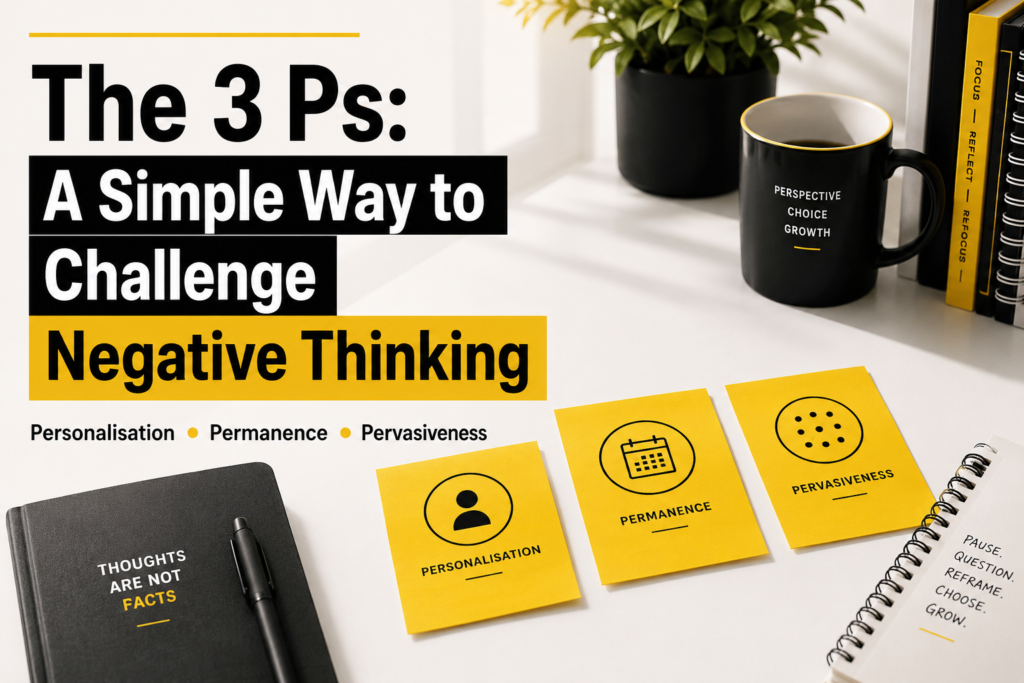
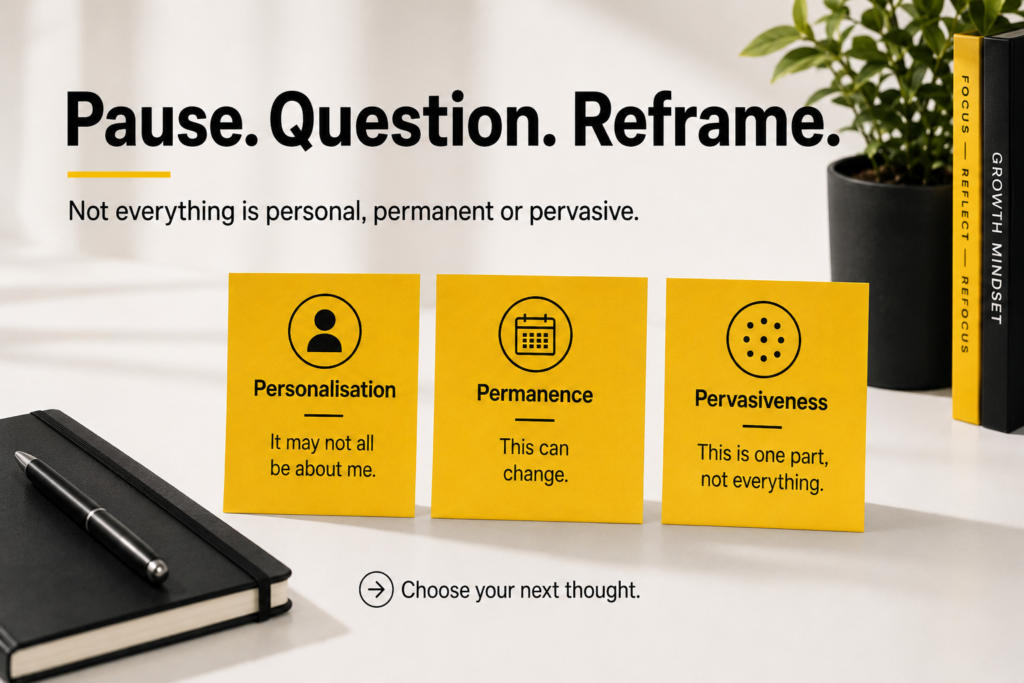
This pattern is described by the 3 Ps model: personalisation, permanence and pervasiveness.
The model comes from research into resilience and explanatory style—the way we explain difficult events to ourselves. It is useful because our explanations matter.
Two people can experience a similar setback and tell themselves very different stories about what it means. Those stories can influence whether they recover, problem-solve and try again—or become stuck in shame, hopelessness and defeat.
This connection between what happens, what we think about it and what we do next is also central to Cognitive Behavioural Coaching, which helps us examine how our interpretations shape our feelings, behaviour and results.
The goal is not to pretend something painful does not matter. It is to notice when your mind has turned one difficult event into a permanent verdict on your entire life.
What Is the 3 Ps Model?
The 3 Ps describe three common ways negative thinking can become broader and more damaging than the original situation.
They are:
- Personalisation: “This is entirely my fault.”
- Permanence: “This will always be this way.”
- Pervasiveness: “This affects everything.”
These thoughts often appear so quickly that they feel like facts rather than interpretations.
Learning to recognise them gives you an opportunity to pause, examine the story and choose a more accurate response.
1. Personalisation: “This Is All My Fault”
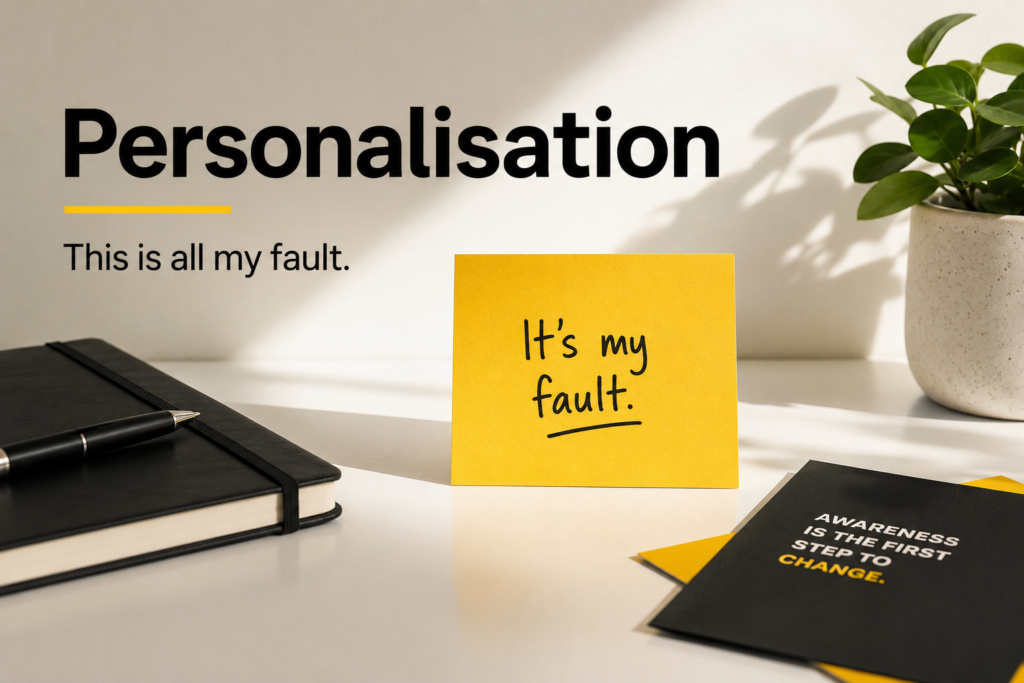
Personalisation happens when you assume a negative event says something fundamental about you—or that you are entirely responsible for what happened.
You may think:
I ruined everything.
I am terrible at this.
They are upset because I did something wrong.
If I had been better, this would not have happened.
Sometimes we are responsible for part of a situation. Mature self-reflection includes being willing to acknowledge mistakes, apologise and make changes.
But personalisation goes further than responsibility.
Responsibility says:
I made a poor decision, and I need to address it.
Personalisation says:
This happened because there is something wrong with me. That distinction matters. A mistake is something you did. It is not the total definition of who you are.
When honest reflection quickly turns into self-criticism, self-compassion can help you take responsibility without beating yourself up or making shame your primary strategy for change.
There may also be other factors involved: timing, unclear communication, another person’s choices, limited information, stress, competing priorities or circumstances outside anyone’s control.
Questions to challenge personalisation
Ask yourself:
- What part of this situation was genuinely mine?
- What part belonged to someone else?
- What external circumstances contributed?
- Am I taking responsibility, or am I taking all the blame?
- Would I judge someone else this harshly for the same mistake?
A more balanced thought might be:
I contributed to this situation, but I was not the only factor.
Or:
I made a mistake. That does not make me a failure.
2. Permanence: “This Will Never Change”
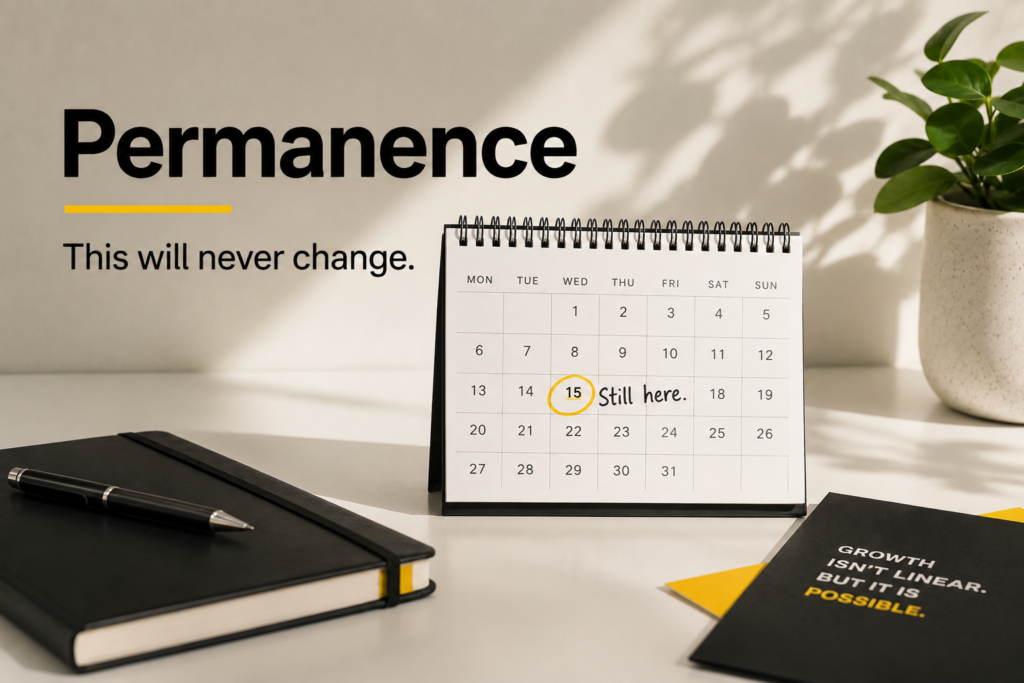
Permanence happens when a present difficulty begins to feel endless.
You may think:
I will always feel like this.
Nothing ever works for me.
I will never get back on track.
This situation is never going to improve.
The trouble with permanence is that it treats a current moment as a reliable forecast of the entire future.
When you are tired, disappointed or frightened, your mind is not always a particularly gifted fortune-teller. It tends to take today’s pain and project it forward indefinitely.
But feelings change. Circumstances change. Skills improve. Information becomes available. People make new decisions. What feels impossible today may look different after rest, support, practice or time.
This does not mean every problem will disappear or every outcome will be the one you hoped for. It means “This is difficult now” is usually more accurate than “This will be difficult forever.”
Questions to challenge permanence
Ask yourself:
- Has this truly been the same forever?
- Have there been times when it felt different?
- What could change, even slightly?
- What support, information or action might influence the situation?
- Am I confusing “I cannot see the solution yet” with “There is no solution”?
A more balanced thought might be:
This is where things are today. It is not proof of where they will always be.
Or:
I do not know how this will change yet, but “not yet” is not the same as “never.”
3. Pervasiveness: “Everything Is Ruined”
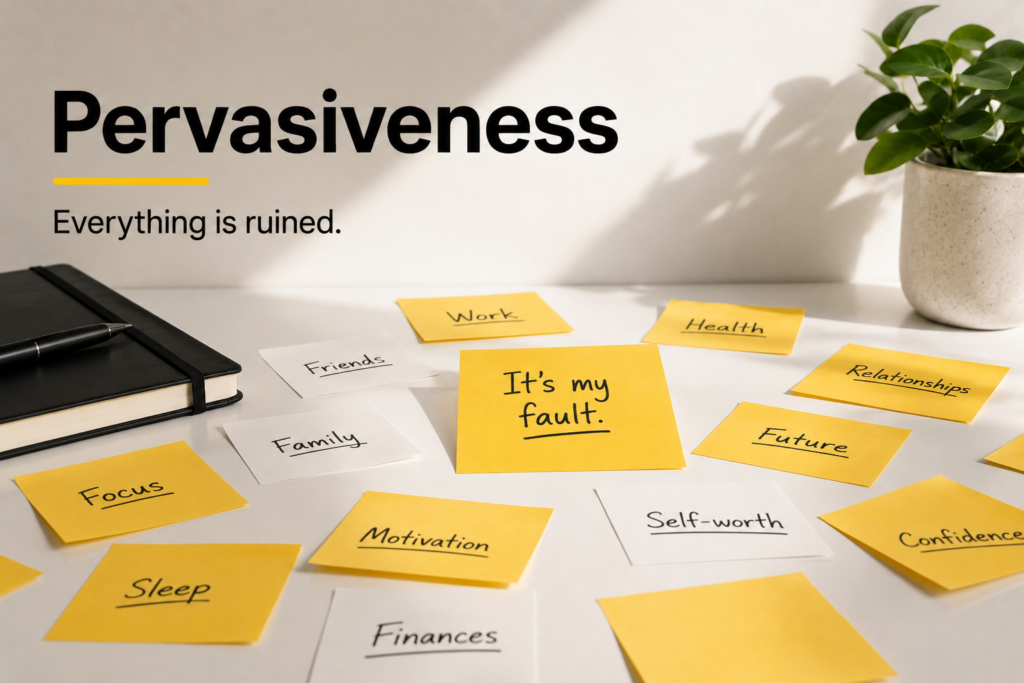
Pervasiveness happens when one problem spreads across your whole view of life.
A conflict in one relationship becomes:
Nobody understands me.
A setback at work becomes:
I cannot do anything right.
A missed week of exercise becomes:
I have no discipline.
One difficult area begins to stain everything else.
This is the mind’s tendency to turn something is wrong into everything is wrong.
Again, the problem itself may be real. But it is rarely the whole story.
You may be struggling financially while still having meaningful relationships. You may feel uncertain about your career while being a caring parent, loyal friend or capable problem-solver. You may have fallen behind on one goal while continuing to manage dozens of other responsibilities.
A difficult chapter is not the whole book.
Questions to challenge pervasiveness
Ask yourself:
- Which specific area of my life is affected?
- What is still working?
- What have I handled well recently?
- Am I using words such as “everything,” “nothing,” “always” or “never”?
- If I described this situation more precisely, what would I say?
A more balanced thought might be:
This part of my life is difficult right now, but it is not my whole life.
Or:
One setback does not erase everything else I have done.
How the 3 Ps Work Together
The three patterns often appear as a package.
Imagine you apply for a role and are unsuccessful.
Personalisation says:
I was rejected because I am not good enough.
Permanence says:
I will never find work I enjoy.
Pervasiveness says:
My whole career is a failure.
The facts may simply be:
I applied for one role and did not get it.
That still may be disappointing. But it is a specific event—not a final judgement on your ability, your future or your entire working life.
A more balanced explanation could be:
I am disappointed that I did not get this role. There may be areas I can improve, and there may also have been strong competition or factors I do not know about. This result applies to one application, not every future opportunity.
Notice that this response is not falsely positive.
It does not say:
Everything happens for a reason. Something better is definitely coming.
Perhaps something better will come. Perhaps it will not arrive neatly wrapped with a motivational quote attached. Balanced thinking does not require you to manufacture certainty. It asks you to stay close to what is actually known.
You can explore this process more fully through the Think-Feel-Act Cycle, which shows how the meaning we give an event can influence how we feel, what we do next and the results we create.
The Aim Is Accuracy, Not Positive Thinking
Challenging the 3 Ps is sometimes misunderstood as replacing every negative thought with a cheerful one. That is not the point.
If something has gone wrong, you are allowed to be disappointed, sad, angry or afraid.
The aim is not:
Everything is wonderful.
The aim is:
This is difficult, but I do not need to make it more devastating by turning it into a judgement about my entire identity and future.
As I explore in Happiness Is Not Positive Thinking, creating a happier life does not require denying pain, suppressing difficult emotions or pasting a cheerful slogan over something that genuinely hurts.
Healthy thinking leaves room for both truth and possibility.
You can say:
I handled that badly.
Without saying:
I am a terrible person.
You can say:
I do not like where my life is right now.
Without saying:
My life will always be this way.
You can say:
This relationship is painful.
Without saying:
Nothing in my life has value.
That is not denial. It is perspective.
A Simple 3 Ps Reflection Exercise
To practise using the 3 Ps model, write down the first explanation that comes to mind when something goes wrong.
The situation
What happened?
Keep your description factual and specific.
For example:
I planned to work on my project this week, but I only completed one of the five tasks I had set.
Personalisation
What are you making this mean about you?
I am lazy and cannot follow through.
Now challenge it:
I underestimated how much time the tasks would take and had several unexpected commitments. I still completed one task.
Permanence
What are you predicting about the future?
I will never finish this project.
Now challenge it:
I did not make the progress I expected this week. I can revise the plan and choose a more realistic next step.
Pervasiveness
How are you allowing this to spread into everything?
I never achieve anything.
Now challenge it:
I am struggling with this particular project. That does not cancel the other things I have completed or managed.
A more balanced explanation
Bring the revised thoughts together:
I did not complete as much as I planned this week. My plan may have been unrealistic, and unexpected commitments reduced the time available. I completed one task and can decide what matters most next week.
This explanation is still honest. But it creates room for learning and action rather than shame and resignation.
When Your Mind Keeps Returning to the Worst Interpretation
Sometimes you will challenge a thought and your mind will immediately offer it back to you. Louder. That does not mean the exercise has failed.
Thought patterns become familiar through repetition, and they usually change through repetition too.
You may need to remind yourself several times:
This feels personal, but other factors were involved.
This feels permanent, but I cannot know that.
This feels like everything, but it is one part of my life.
You do not have to believe the balanced thought completely at first. You only need to recognise that the original thought may not be the only possible explanation. That small gap matters. It is the space between reacting automatically and choosing your response.
You Are Allowed to Tell a More Accurate Story
We all explain our lives to ourselves. We decide what events mean, what they reveal about us and what they predict about the future. Those explanations can become habits.
A setback can become evidence that we are incapable. A painful season can become proof that nothing will change. One struggling area can eclipse everything else.
But thoughts are not sacred simply because they arrived quickly. They can be questioned.
The next time your mind tells you:
It is all my fault.
It will always be this way.
Everything is ruined.
Pause.
Pause.
Use the 3 Ps model to notice what your mind is doing.
Then ask:
Is that the whole truth—or is it the most painful interpretation available?
You may still have a problem to solve. You may still need to grieve, repair, decide or act. But you can do that without turning one difficult moment into a life sentence.
Your circumstances matter. Your thoughts matter too. And your life is still yours to shape.
Ready to Turn Insight Into Action?
Understanding your thinking patterns is useful. Learning to respond differently is where change begins.
If you are tired of collecting self-development advice but struggling to put it into practice, my coaching and programs are designed to help you slow down, understand what is happening and choose practical next steps.
You do not need to change your entire life today. You only need to find the next decision point.
Pause. Notice. Choose.
Live well and love the life you create.

Megan Ruffino is a professional life coach, Master NLP Practitioner and trainer who writes about happiness, self-coaching and personal growth. She helps people understand themselves more clearly, make conscious choices and take practical steps toward lives that feel happier and more empowered.