
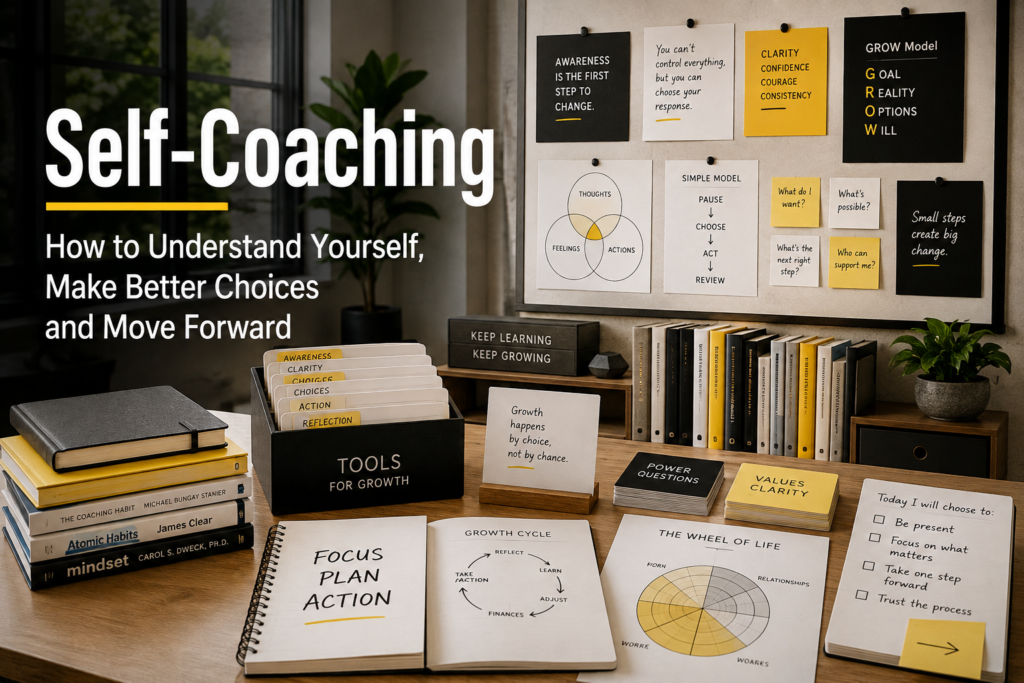
There are times when you know something in your life needs attention, but you do not necessarily need someone else to tell you what to do.
You may be facing a decision, trying to change a habit or wondering why you keep reacting in the same way. You may not be in crisis. You may simply feel stuck, unsettled or ready for something to change.
This is where self-coaching can be useful.
Self-coaching is the practice of slowing down, looking honestly at what is happening and asking yourself questions that help you understand your experience more clearly. It can help you recognise patterns that usually run on autopilot, see choices you may have overlooked and take more deliberate action.
It is not about endlessly analysing yourself or trying to think your way out of every uncomfortable feeling. Nor is it about turning your life into a permanent improvement project in which you journal at dawn, drink green juice and have colour-coded feelings before breakfast.
Self-coaching is simply a way to become more aware of what is happening within you and around you, so you have more choice in how you respond.
You may not be able to control everything that happens in your life. You can, however, become more intentional about what you make it mean and what you do next.
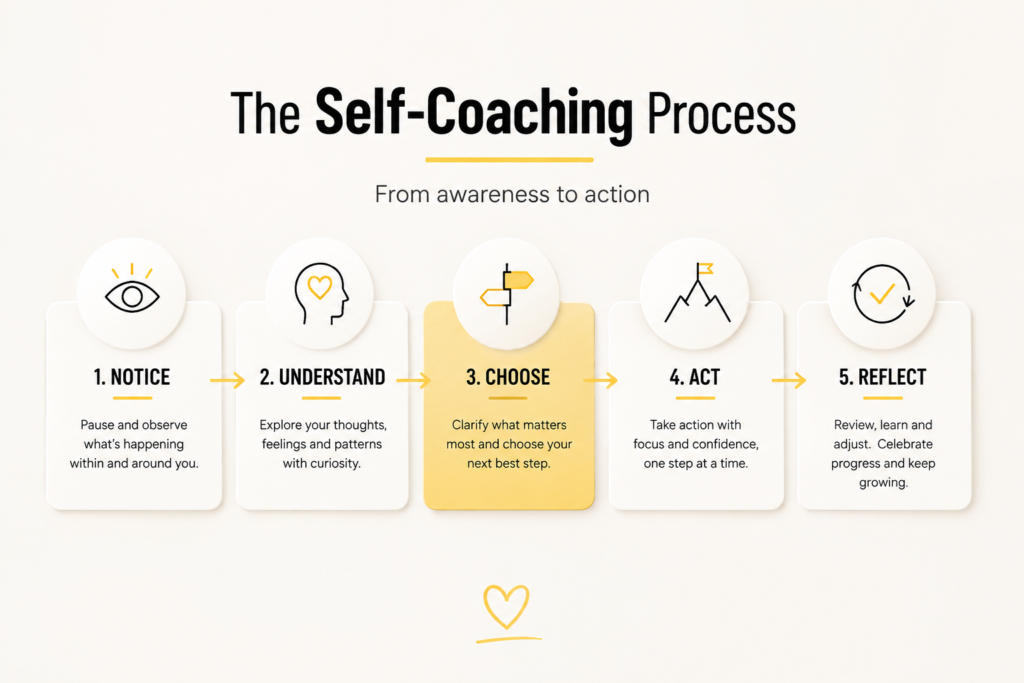
The Self-Coaching Process
Notice what is happening. Understand what may be driving it. Choose how you want to respond. Act on one useful step. Reflect on what you learned.
In This Guide
- What Is Self-Coaching?
- Why Self-Coaching Can Be Helpful
- A Simple Self-Coaching Process
- Which Self-Coaching Tool Do I Need?
- How to Choose and Combine Coaching Models
- Questions to Ask When Coaching Yourself
- When Self-Coaching Is Not Enough
- Help Shape a Future Self-Coaching Membership
- Support Through Coaching
What Is Self-Coaching?
Self-coaching means using reflective questions and practical coaching tools to help yourself work through a challenge, goal, decision or recurring pattern.
A good coach does not usually hand you a neat answer or tell you how to live your life. Instead, they help you step back from the noise of the situation, examine what may be influencing you and consider what you want to do next.
Self-coaching attempts to create some of that space for yourself. You become both the person having the experience and the person willing to examine it.
You might ask:
- What is actually happening here?
- What am I thinking and feeling?
- What do I want?
- What am I assuming?
- What choices do I have?
- What am I avoiding?
- What is one useful step I can take?
These questions may sound simple, but most of us do not naturally pause to ask them when we are upset, overwhelmed or caught in an old pattern. We react, replay familiar thoughts, focus on what someone else should do or try to solve the entire problem at once.
Self-coaching interrupts that automatic process. It gives you a chance to move from reacting to responding.

Self-Coaching Is Not Positive Thinking in Disguise
Self-coaching is sometimes mistaken for replacing every uncomfortable thought with a cheerful one.
That is not the point.
Some situations are genuinely painful, unfair, uncertain or disappointing. You do not need to pretend otherwise. Looking at a difficult experience and insisting that everything is wonderful is not self-coaching. It is denial wearing a motivational badge.
Good self-coaching begins with honesty. You acknowledge what has happened and recognise what you feel. You then examine your interpretation without assuming that every thought is either completely true or completely false.
The aim is not to feel positive all the time. It is to understand yourself well enough to choose a response that is useful, honest and consistent with the person you want to be.
Why Self-Coaching Can Be Helpful
Much of what we do each day is automatic. We develop familiar ways of thinking, feeling and responding. Some of these patterns serve us well. Others were formed in different circumstances and may no longer fit the life we are living now.
You may avoid conflict because speaking up once felt unsafe. You may overcommit because being useful has become closely tied to being valued. You may procrastinate because beginning brings up fear of failure or judgement. You may continue pursuing a goal that no longer matters because you have already invested so much in it.
Without reflection, these patterns can begin to feel like fixed facts about who you are:
- I am bad at boundaries.
- I never follow through.
- I cannot make decisions.
- I have always been this way.
Self-coaching turns those conclusions into questions:
- What makes boundaries difficult for me?
- What happens just before I stop following through?
- What am I afraid a decision might cost me?
- Where did I learn to respond this way?
- Is this pattern still protecting me, or is it now limiting me?
Once you can see a pattern more clearly, you have more choice. Awareness is not a magic wand, and understanding a behaviour does not automatically change it. But it is difficult to change a pattern you cannot yet recognise.
A Simple Self-Coaching Process
There are many coaching models, and different models suit different situations. You do not, however, need a formal worksheet every time you want to think something through.
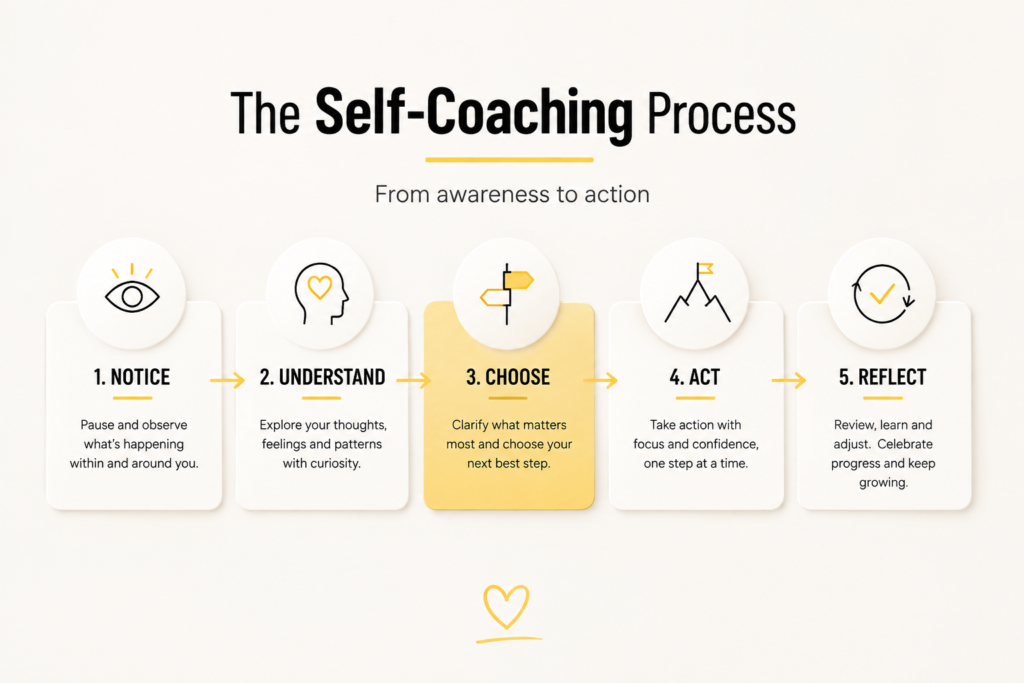
A simple process you can return to is:
Notice → Understand → Choose → Act → Reflect
These stages are not rigid steps that must be completed perfectly. They are prompts that help you slow down, examine what is happening and respond more deliberately.
A Self-Coaching Example
Imagine you have agreed to take on another responsibility even though you are already overwhelmed.
- Notice: I said yes immediately, but now I feel resentful and anxious.
- Understand: I was afraid the other person would think I was selfish or unhelpful.
- Choose: I want to be supportive without automatically sacrificing my own capacity.
- Act: I will explain that I cannot take on the whole task, but I can help with one smaller part.
- Reflect: The conversation was uncomfortable, but the other person accepted my answer. I did not need to justify myself as much as I expected.
Notice: What Is Happening?
Begin by observing what is happening without immediately rushing to fix, judge or explain it.
You may notice that you become defensive whenever someone gives you feedback. You may realise that you agree to requests and later feel resentful. You may see that you repeatedly set goals that require more time, energy or motivation than you realistically have.
Useful questions include:
- What am I doing?
- What am I thinking?
- What am I feeling?
- What keeps happening?
- What am I avoiding?
- When does this pattern usually appear?
Noticing requires curiosity. Instead of asking, “Why am I like this?” try asking, “What is happening here?”
The first question sounds like a verdict. The second gives you something to investigate.
You are not gathering evidence for the prosecution. You are observing a pattern.
Understand: What Is Beneath It?
Once you have identified the pattern, explore what may be driving it.
A behaviour that looks like laziness may be connected to confusion, exhaustion or fear of failure. People-pleasing may appear to be kindness while also functioning as a strategy for avoiding rejection or conflict. Anger may be covering hurt, fear or a sense of powerlessness.
Ask yourself:
- What thoughts or assumptions are present?
- What am I afraid might happen?
- What need am I trying to meet?
- What value feels threatened?
- What does this behaviour help me avoid?
- What past experience may be influencing my response?
Understanding does not mean excusing every behaviour. It means identifying the real problem before prescribing a solution.
Trying to change a behaviour without understanding what drives it can be like repeatedly cutting the top off a weed while leaving the roots comfortably underground.
Choose: How Do I Want to Respond?
When you understand more about what is happening, you can begin to consider your choices.
Choice does not mean that every option will be easy or appealing. Sometimes each available option carries a cost. You may need to choose between temporary discomfort and continuing a pattern that is hurting you. You may need to disappoint someone else rather than keep abandoning yourself.
Consider:
- What matters most here?
- What is within my control?
- What options do I have?
- What would a respectful response look like?
- What kind of person do I want to be in this situation?
- Which choice best reflects my values and current capacity?
Self-coaching does not remove the difficulty of a decision. It helps you make the decision consciously rather than allowing fear, habit or pressure to make it for you.
Act: What Will I Do?
Insight matters, but insight alone does not change your life. Eventually, something needs to happen.
The action may be visible, such as making a phone call, setting a boundary, completing a task or asking for help. It may also be internal, such as allowing an emotion without reacting impulsively, questioning an assumption or deciding not to continue rehearsing an argument in your head.
Ask:
- What is one practical next step?
- What am I genuinely willing to do?
- Can I make the step smaller or more manageable?
- What preparation or support would help?
- When will I do it?
The best action is not always the largest or most impressive one. A small action completed is generally more useful than an elaborate plan repeatedly postponed.
Reflect: What Did I Learn?
After you have acted, pause and consider what happened.
You might ask:
- What worked?
- What did not work?
- What surprised me?
- What became easier?
- What still needs attention?
- What will I repeat or change next time?
Reflection turns experience into learning. Without it, we can repeat the same approach and blame ourselves when it produces the same result.
Perhaps the step was too large. Perhaps the timing was wrong. Perhaps you discovered that the goal did not matter as much as you thought. Perhaps you handled the situation better than you are giving yourself credit for.
Self-coaching is not a straight line from problem to perfect solution. It is an ongoing process of noticing, learning, adjusting and choosing again.
Different Problems Need Different Coaching Tools
There is no single coaching model that works best for every situation.
One model may help you clarify a goal, while another helps you uncover the belief beneath your behaviour. Some tools are useful for planning and decision-making. Others help with emotional patterns, relationships, confidence or life balance.
You do not need to master every model before using any of them. Think of each model as a different lens. You can try one, notice what it helps you see and decide whether it is useful.
The purpose of a coaching model is not to squeeze your life into a tidy diagram. It is to help you ask better questions.
Which Self-Coaching Tool Do I Need?
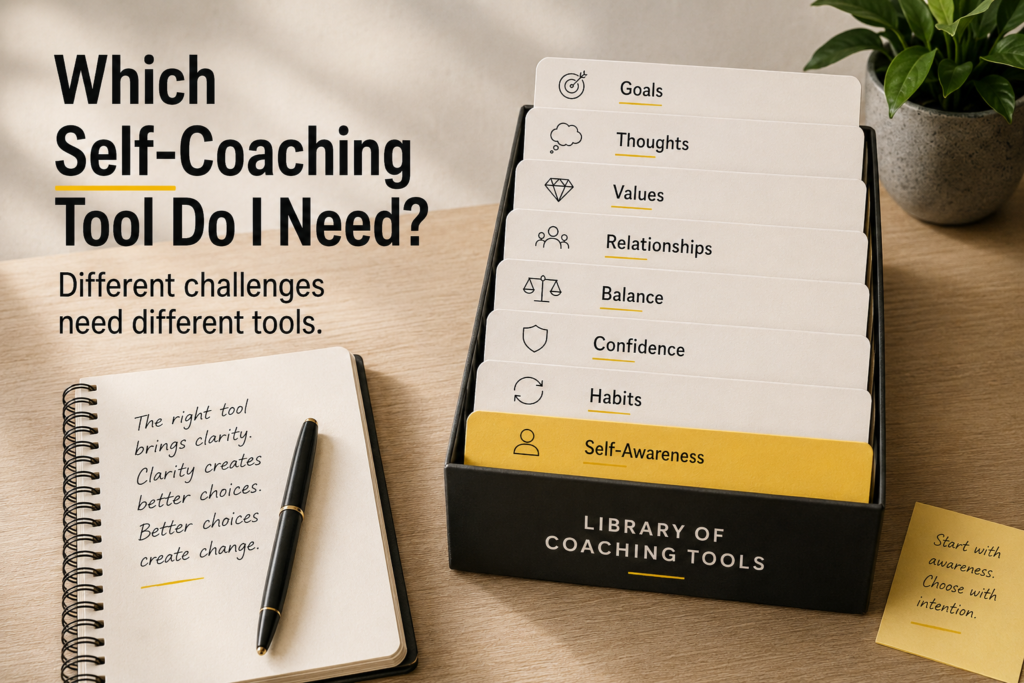
Not sure where to start?
Begin with the five-step self-coaching process. If you need more structure, choose the model that most closely matches the question you are trying to answer. You do not need to learn every tool before using one.
Here is a quick guide to choosing a model based on what you are facing:
- You feel stuck and need a clear way forward: Try the GROW Model.
- You know what you want but struggle to follow through: Try WOOP.
- Your whole life feels slightly off: Try the Wheel of Life.
- You feel stretched too thin: Explore the Life Balance Model.
- Your own behaviour does not make sense to you: Use the Iceberg Model.
- Your thinking is creating an unhelpful pattern: Try Cognitive Behavioural Coaching.
- You want to understand a specific emotional reaction: Use the Think–Feel–Act Cycle.
- You need to make a decision that feels right for you: Clarify your values.
- You keep falling into unhelpful relationship roles: Explore the Drama Triangle.
- You want to deepen your self-awareness: Use the Johari Window.
- Fear is keeping you inside what is familiar: Try the Comfort Zone Model.
- Self-criticism is making change harder: Practise self-compassion.
You can explore each model in more detail below.
When You Feel Stuck and Need a Clear Way Forward: The GROW Model
The GROW Model is one of the most widely used coaching frameworks because it offers a practical structure for working through a problem.
GROW stands for Goal, Reality, Options and Way Forward. It helps you clarify what you want, take an honest look at where you are now, consider your available choices and decide what you will do next.
Use the GROW Model when your thoughts are going around in circles and you need a clear route from confusion to action. It is particularly useful for decisions, goals, workplace challenges and situations in which you keep asking, “What should I do?”
When You Know What You Want but Struggle to Follow Through: The WOOP Method
The WOOP Method helps turn a wish into a realistic plan.
WOOP stands for Wish, Outcome, Obstacle and Plan. Unlike approaches that focus only on imagining success, WOOP asks you to identify the internal obstacle most likely to get in your way. You then create a plan for how you will respond when it appears.
Use WOOP when you genuinely want something but keep losing momentum, becoming distracted or returning to a familiar behaviour. It can be especially useful for building habits, completing projects and preparing for the predictable moments when motivation disappears without leaving a forwarding address.
When Your Whole Life Feels Slightly Off: The Wheel of Life
The Wheel of Life helps you step back and consider the different areas of your life.
You rate your satisfaction in areas such as health, relationships, work, finances, personal growth and recreation. The resulting wheel gives you a visual snapshot of where life feels satisfying and where something may need more attention.
Use the Wheel of Life when you feel flat, restless or dissatisfied but cannot identify the source. It can help you choose where to begin without attempting to renovate your entire life before Monday.
When Your Life Feels Out of Balance: The Life Balance Model
The Life Balance Model helps you think more realistically about balance.
A balanced life does not require giving equal time and energy to every area. Different seasons ask different things of us. The more useful question is whether your current use of time, energy and attention supports the life you are actually living.
Use this model when you feel stretched too thin, guilty about what you are not doing or unsure whether a goal fits your present circumstances. Sometimes the answer is not greater discipline. Sometimes it is rearranging the load.
When Your Behaviour Does Not Make Sense to You: The Iceberg Model
The Iceberg Model reminds us that visible behaviour is often only the tip of the story.
Beneath an action may sit thoughts, emotions, fears, assumptions, values, memories and beliefs about who we are.
Use the Iceberg Model when you keep repeating a behaviour even though you know it is unhelpful. Instead of asking only, “How do I stop doing this?” the model encourages you to ask, “What is this behaviour doing for me, protecting me from or helping me avoid?”
That deeper understanding may lead to a more useful response than simply telling yourself to try harder.
When Your Thoughts Are Shaping an Unhelpful Pattern: Cognitive Behavioural Coaching
Cognitive Behavioural Coaching helps you examine the connection between your thoughts, feelings, actions and results.
You begin by identifying what happened and what you thought about it. You then notice how that interpretation influenced what you felt and did.
Use this approach when a recurring thought is affecting your confidence, mood, behaviour or relationships. The aim is not to force yourself to think positively. It is to determine whether your current interpretation is accurate, useful and complete, and whether another perspective might help you respond more effectively.
When You Want to Understand a Reaction: The Think–Feel–Act Cycle
The Think–Feel–Act Cycle helps you see how your interpretation of a situation influences your feelings and actions.
Two people can experience the same event and respond very differently because of what they believe the event means.
Use this tool when you want to slow down a reaction and identify the thought sitting between the circumstance and the emotion. It can be especially useful when you find yourself thinking, “They made me feel this way.”
Another person’s behaviour may matter greatly, but your interpretation will also influence your experience and what you do next. Recognising that gives you somewhere to work. It does not excuse the other person’s behaviour or make you responsible for everything that happens to you.
When You Need to Make a Decision That Feels Right for You: Values Clarification
Values Clarification helps you identify what genuinely matters to you.
Values are the principles and qualities you want your choices to reflect. They may include honesty, security, kindness, freedom, family, creativity or adventure.
Use values work when you feel torn between competing options or when your life looks acceptable from the outside but does not feel right. A decision can be sensible and still take you away from what matters most.
Values provide a compass. They may not reveal the exact route, but they can help you recognise when you are travelling in the wrong direction.
When You Keep Falling Into Unhelpful Relationship Roles: The Drama Triangle
The Drama Triangle describes three roles people may move between during conflict or stress: Victim, Rescuer and Persecutor.
These are not fixed personality types. They are patterns of responding. You may feel powerless, rush in to solve another person’s problem or become critical when your help is not accepted.
Use the Drama Triangle when relationships repeatedly leave you feeling responsible, resentful, helpless or blamed. Recognising the role you have stepped into can help you move toward a response based on responsibility, boundaries and honest communication.
When You Want to Understand Yourself More Deeply: The Johari Window
The Johari Window explores what is known and unknown about you, both to yourself and to other people.
It helps you consider the parts of yourself you recognise, the qualities others may see more clearly, the things you choose to keep private and the aspects of yourself that remain undiscovered.
Use the Johari Window when you want to increase self-awareness, seek useful feedback or understand the difference between how you see yourself and how others experience you.
Self-knowledge does not come only from looking inward. Sometimes another person holds a piece of the mirror.
When Fear Is Keeping You Inside What Is Familiar: The Comfort Zone Model
The Comfort Zone Model describes the movement from familiarity through fear and learning toward greater capacity.
It can help you recognise when discomfort is a natural part of trying something new. Use it when you are hesitating at the edge of a change, comparing yourself with others or waiting to feel completely confident before you begin.
The model should not, however, become another stick to beat yourself with. Not every period of comfort is stagnation. Sometimes you need rest, stability or a greater sense of safety before taking on another challenge.
Healthy growth involves stretch, not self-punishment.
When Self-Criticism Is Making Change Harder: Self-Compassion
Self-compassion as a coaching tool helps you respond to difficulty with understanding rather than shame.
Self-compassion does not mean avoiding responsibility or pretending that everything you do is fine. It means acknowledging that you are struggling, remembering that difficulty is part of being human and choosing a kind but useful response.
Use self-compassion when your inner critic is making it harder to learn, recover or take action. You can hold yourself accountable without humiliating yourself. In fact, many people become more willing to face the truth when they know they will not use it as ammunition against themselves.
How to Choose and Combine Coaching Models
You do not need to choose the perfect model. Begin with the question that feels most important:
- Do I need to understand what is happening?
- Do I need to clarify what I want?
- Do I need to examine my thinking?
- Do I need a practical plan?
- Do I need to understand a relationship pattern?
- Do I need to treat myself more kindly while I work through this?
Choose the tool that best matches your question and experiment with it. Write your responses down if you can. Thoughts often seem clear while they are circling in your head, but become rather less convincing once they are standing on paper in daylight.
You can also combine models. For example:
- Use the Wheel of Life to identify an area that needs attention, values clarification to decide what matters within that area, and GROW to choose your next step.
- Use the Iceberg Model to explore what drives a recurring behaviour, then the Think–Feel–Act Cycle to examine a specific situation.
- Use WOOP to anticipate the obstacle most likely to derail a goal, then self-compassion to respond constructively if you stumble.
- Use the Drama Triangle to recognise a relationship pattern, then GROW to plan a more empowered response.
The models are not competing religions. They are tools. Use what helps.
Questions to Ask When Coaching Yourself
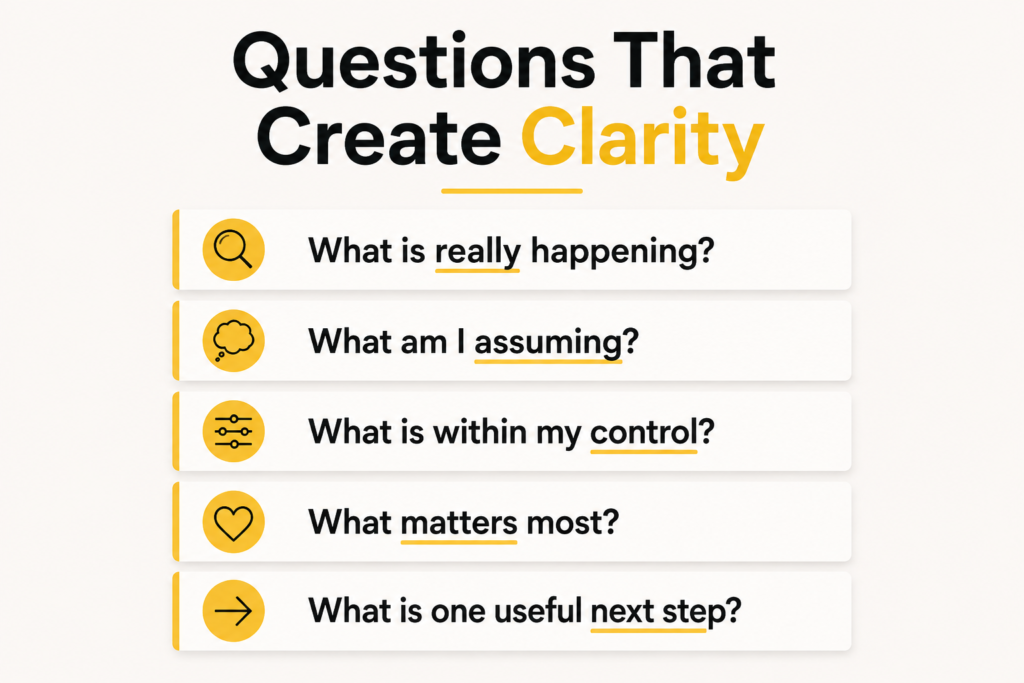
When you are unsure where to begin, choose one or two questions from the following list:
- What is actually happening?
- What am I telling myself about it?
- What am I feeling?
- What am I doing in response?
- What result is that creating?
- What do I want instead?
- What part of this is within my control?
- What am I avoiding because it feels uncomfortable?
- What might I be assuming?
- What matters most here?
- What options have I not considered?
- What would one small, honest next step look like?
- What support might help?
You do not need to answer every question. Choose the one that makes you pause. That is often where the useful work begins.
When Self-Coaching Is Not Enough

Self-coaching can be powerful, but it has limits. You are trying to examine your own thinking from inside the mind that created it. That is rather like trying to read the label from inside the jar.
You may have blind spots. You may keep asking questions that reinforce what you already believe, avoid the issue that feels most threatening or use reflection as a substitute for taking action.
Self-coaching is also not a replacement for:
- medical care;
- mental health treatment;
- trauma therapy;
- crisis or safety support;
- legal or financial advice;
- specialist professional guidance.
Seek appropriate support when you are experiencing severe or persistent distress, struggling to function, feeling unsafe or dealing with an issue beyond the scope of general personal development.
You may also benefit from support when you are not in crisis but cannot see your own situation clearly. Perhaps you understand a pattern intellectually but continue repeating it. Perhaps your choices feel tangled with fear, guilt or other people’s expectations. Perhaps you know what you want but cannot work out why you are not moving toward it.
A life coach can help you notice assumptions and contradictions you may not hear yourself. They can ask questions that take you beyond your usual explanations and help you turn insight into practical action.
A good coach should not take over your decisions or make you dependent on their answers. The aim is to help you hear your own answers more clearly and become increasingly able to coach yourself between sessions.
Sometimes the most valuable result of self-coaching is recognising that support is the wisest next step.
Self-Coaching Is a Practice
Self-coaching is not something you master once and then perform perfectly forever.
Some days you will notice a thought quickly and choose a thoughtful response. On other days, you will react, make the situation worse, think of the ideal response in the shower three hours later and wonder why this wisdom was unavailable when it was needed.
That is part of being human.
The practice is not about never reacting. It is about becoming more willing to notice, understand and choose again.
Over time, you may begin to recognise patterns earlier. You may become less frightened of difficult emotions and more honest about what you want. You may recover more quickly when you fall into an old response.
That is meaningful progress: not perfection, but greater awareness, more choice and a growing ability to shape your life deliberately rather than simply repeating what is familiar.
Help Shape a Future Self-Coaching Membership
I am currently exploring the idea of creating a self-coaching membership designed to help people understand themselves more clearly, work through challenges and make thoughtful changes in their lives.
Before I build anything, I want to hear from the people it may actually serve.
I have created a short survey asking what you would find most useful in a self-coaching membership, what kind of support you would value and what might make you want to join.
If the Self-Coaching Studio sounds like something you would like to be part of, add your name to the interest list and I will keep you updated as it comes together.
If this is something you may be interested in, I would be grateful if you would share your thoughts.
Complete the short self-coaching membership survey
A Final Thought
Self-coaching begins with a willingness to pause and pay attention.
You do not need to have all the answers, use every model or turn every difficult moment into a lesson. You can begin by noticing what is happening, asking one useful question and taking one step that feels honest and manageable.
As you understand yourself more clearly, you create more choice. With more choice, you have greater power to influence the direction of your life.
That does not mean controlling every outcome. It means becoming an active participant in the life you are creating.
Support Through Coaching
Self-coaching can be a powerful place to start. It helps you slow down, notice your patterns and ask better questions. But sometimes it is difficult to see your own thinking clearly from inside the middle of your own life. That is where coaching can help.
A life coach will not tell you what to do or magically fix your life. A good coach can help you untangle your thoughts, reconnect with what matters and take practical steps toward the life you want to create.
If you would like support with this, you are welcome to reach out and explore coaching with me.

Megan Ruffino is a professional life coach, Master NLP Practitioner and trainer who writes about happiness, self-coaching and personal growth. She helps people understand themselves more clearly, make conscious choices and take practical steps toward lives that feel happier and more empowered.