
Cognitive behavioural coaching helps us understand why we respond the way we do, especially when our thoughts, feelings and actions seem to happen automatically.
Most of us like to think we are reacting to life itself.
Someone says something rude, and we feel upset. Something goes wrong at work, and we feel stressed. We make a mistake, and we feel embarrassed. Life happens, and our feelings seem to arrive automatically, as if they are the only possible response.
But often, there is something happening in the middle that we do not notice.
Between what happens and how we respond, there is usually a thought, an interpretation, a judgement, or a meaning we have attached to the situation. Cognitive Behavioural Coaching helps us slow that process down and look at it more clearly.
This does not mean pretending everything is fine. It does not mean forcing yourself to “think positive” when life is genuinely hard. It simply means learning to notice the connection between a situation, your thoughts about it, your feelings, your behaviour, and the results you create from there.
That is useful. Very useful, actually. Because once you can see the pattern, you have more room to choose.
What Is Cognitive Behavioural Coaching and How Does It Work?
Cognitive Behavioural Coaching is a practical coaching approach based on the idea that the way we think about a situation influences how we feel and behave. It is closely related to cognitive behavioural ideas used in psychology, but in coaching it is generally applied to everyday challenges, goals, habits, decisions, confidence, motivation, and personal development.
A simple version of the model looks like this:
Situation → Thoughts → Feelings → Behaviour → Results
Something happens. You have thoughts about it. Those thoughts influence how you feel. Your feelings influence what you do or avoid doing. Your actions then contribute to the results you get.
This is very close to the Think, Feel, Act model I often use in coaching and self-development work. The main difference is that Cognitive Behavioural Coaching gives us a slightly more detailed chain to explore. It helps us see not only that thoughts affect feelings and actions, but also how those actions shape the outcomes we keep getting.
It is not about blaming yourself for every result in your life. That would be simplistic and, frankly, unhelpful. Some circumstances are genuinely difficult. Some people behave badly. Some situations are unfair. Coaching does not require us to deny reality.
The point is not that you control everything.
The point is that you may have more influence than you realise over the meaning you make, the response you choose, and the next step you take.
Coaching, Not Therapy
It is important to make a clear distinction here.
Cognitive Behavioural Coaching is not a replacement for therapy, mental health care, trauma support, or medical treatment. If you are dealing with clinical anxiety, depression, trauma, panic, severe distress, or anything that significantly affects your ability to function, it is wise to seek support from a qualified health professional.
For a simple health-based explanation of CBT as a therapy approach, the Better Health Channel has a helpful overview of cognitive behaviour therapy.
Coaching works best when we are looking at everyday patterns such as procrastination, self-doubt, overthinking, avoidance, perfectionism, people-pleasing, motivation, confidence, decision-making, and goal-setting.
For example, coaching might help you explore why you keep putting off applying for a job, why you avoid difficult conversations, why you talk yourself out of trying something new, or why one small setback makes you want to give up completely.
That is the lane we are staying in here.
Everyday thoughts. Everyday behaviours. Everyday change.
How The Model Works
Let’s break the model down.
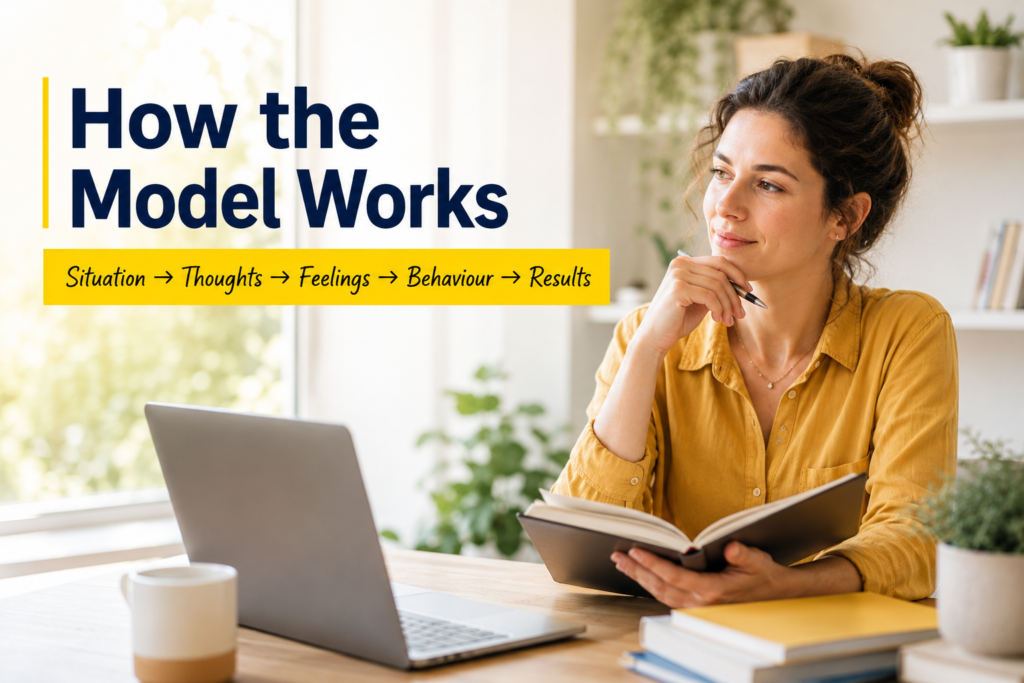
A situation is the thing that happens. It is the circumstance, event, conversation, task, mistake, delay, comment, bill, email, invitation, opportunity, or problem.
Your thoughts are what you tell yourself about the situation. This may happen quickly and quietly in the background. You might think, “I can’t handle this,” “They must be annoyed with me,” “I always mess things up,” “This is too hard,” or “There’s no point trying.”
Your feelings are the emotional response that follows. Depending on your thoughts, you may feel anxious, frustrated, embarrassed, resentful, hopeful, calm, motivated, discouraged, or overwhelmed.
Your behaviour is what you do next. You might avoid, argue, withdraw, procrastinate, overwork, apologise unnecessarily, seek reassurance, take action, ask for help, make a plan, or give up.
Your results are what those behaviours create over time. Avoiding the task may give you short-term relief, but it also leaves the task unfinished. Taking one small step may feel uncomfortable at first, but it builds evidence that you can move forward.
This is why the model can be so powerful. It shows us that behaviour rarely appears out of nowhere. There is usually a thought pattern underneath it.
A Simple Example
Imagine you receive an email from your manager saying, “Can we talk tomorrow?”
That is the situation.
One person might think, “I’m in trouble. I must have done something wrong.” They may feel anxious, spend the evening worrying, struggle to sleep, and arrive at the meeting tense and defensive.
Another person might think, “I wonder what this is about. I’ll find out tomorrow.” They may feel curious or mildly uncertain, but they are less likely to spiral.
Same situation. Different thoughts. Different emotional response. Different behaviour.
This does not mean the second person is magically calm because they are better at life. It simply means the meaning they attached to the email was different.
Many of us do not realise how often we are reacting not only to the event itself, but to the story we have built around it.
Why Your Thoughts Matter
Your thoughts matter because they influence what feels possible.
If you think, “I’m terrible at this,” you are more likely to feel discouraged and avoid practising. If you think, “I’m still learning this,” you may feel more willing to try again.
If you think, “I’ve ruined everything,” you may feel ashamed and withdraw. If you think, “I made a mistake and I need to repair it,” you are more likely to take responsibility and act.
If you think, “I never stick to anything,” you may give up at the first wobble. If you think, “I’m building consistency and I missed one day,” you are more likely to restart.
The thought does not have to be wildly positive. In fact, wildly positive thoughts often do not work because you do not believe them. If you feel overwhelmed and someone tells you to say, “Everything is amazing and I am unstoppable,” your mind may quite rightly roll its eyes and mutter, “Please be serious.”
A useful thought is not necessarily the most positive thought.
A useful thought is one you can believe, and one that helps you respond more effectively.
The Problem With Automatic Thoughts
Many of our thoughts are automatic. They appear so quickly that we do not question them.
You might immediately assume criticism means rejection. You might assume a delay means failure. You might assume someone else’s mood is your fault. You might assume discomfort means danger. You might assume not knowing how to do something means you are not capable of learning.
These automatic thoughts often come from old experiences, habits, beliefs, family patterns, school experiences, workplace culture, or repeated emotional conditioning. We are not born with all our interpretations fully formed. We learn them, practise them, and eventually mistake them for truth.
This is where the Iceberg Model can also be useful, because it helps explain why our visible behaviour is often driven by deeper beliefs, emotions, and assumptions.
Cognitive Behavioural Coaching helps us pause and ask, “What am I thinking here?” That question alone can create a little breathing space.
Not a miracle. Not a magic wand. But space.
And sometimes space is where change begins.
Common Thought Patterns That Keep People Stuck
There are several common thinking patterns that can quietly influence our behaviour.

One is all-or-nothing thinking. This is when you see things as total success or total failure. You ate one unplanned snack, so the whole day is ruined. You missed one walk, so you have failed at getting fit. You stumbled during a conversation, so you decide you are hopeless with people.
Another is mind reading. This is when you assume you know what someone else is thinking. They did not reply, so they must be annoyed. They looked distracted, so they must think you are boring. They gave brief feedback, so they must be disappointed in you.
Another is catastrophising. This is when your mind leaps to the worst possible outcome. One mistake becomes “I’ll lose my job.” One awkward conversation becomes “They’ll never respect me again.” One setback becomes “Nothing ever works out for me.”
There is also discounting the positive, where you brush away anything that does not fit your negative view of yourself. Someone compliments your work, and you think, “They’re just being nice.” You make progress, and you think, “It doesn’t count because it took too long.”
These patterns are not character flaws. They are mental habits. The good news is that habits can be noticed, questioned, and gradually changed.
How To Use Cognitive Behavioural Coaching On Yourself
You can use this model as a simple self-coaching exercise.
If you like structured self-coaching tools, you may also find the GROW coaching model helpful for turning insight into clear next steps.
Start by writing down the situation. Keep it factual. Try to describe what actually happened, not your interpretation of what happened. For example, “My friend did not reply to my message for two days” is a situation. “My friend is ignoring me because I am annoying” is a thought.
Next, write down your thoughts. What are you telling yourself about this situation? What meaning have you attached to it? What are you assuming? What are you predicting? What are you making it mean about you, them, or the future?
Then notice your feelings. Are you feeling anxious, sad, angry, guilty, embarrassed, resentful, flat, motivated, hopeful, or something else? Try to name the feeling without judging it.
After that, look at your behaviour. What are you doing because you feel this way? Are you avoiding, pushing, pleasing, withdrawing, over-explaining, numbing, scrolling, snapping, procrastinating, or taking useful action?
Finally, look at the result. What does this behaviour create? Does it move you closer to the kind of person you want to be? Does it solve the problem? Does it create more stress later? Does it help in the short term but hurt in the long term?
This process is not about criticising yourself. It is about understanding the pattern.
And once you understand the pattern, you can start testing a new one.
Choosing A More Useful Thought
Once you have identified the thought that is driving the pattern, you can ask a better question.
Not “How do I make myself think positively?”
A better question is, “What is a more useful and believable way to think about this?”
For example, instead of “I always fail,” you might try, “I have struggled with this before, but I can take one small step today.”
Instead of “They must be judging me,” you might try, “I do not actually know what they are thinking.”
Instead of “This is too hard,” you might try, “This is difficult, and I can break it down.”
Instead of “I should be further ahead by now,” you might try, “I am allowed to begin from where I am.”
The new thought does not need to make you feel instantly confident. Sometimes it simply needs to reduce the emotional intensity enough for you to take the next sensible step.
That is often enough.
A Practical Example: Procrastination
Let’s say you have been putting off a task.
The situation is: “I need to write a report.”
Your thought might be: “I do not know where to start, and it probably will not be good enough.”
The feeling might be overwhelm or dread.
The behaviour might be avoiding the report, checking emails, doing easier tasks, cleaning the kitchen, or suddenly deciding that now is the perfect time to reorganise your entire filing system. Very noble. Very sneaky.
The result is that the report remains unwritten, the deadline gets closer, and your stress increases.
Using the model, you might choose a more useful thought: “I do not need to write the whole report right now. I only need to create a rough outline.”
That thought may create a slightly calmer feeling. The behaviour becomes opening the document and writing headings. The result is progress.
Not perfection. Progress.
That is how change often works in real life. It is usually less dramatic than we imagine, but more effective than waiting for motivation to arrive wearing a cape.
If procrastination is a pattern you recognise, you may also like this article: Stop Waiting To Feel Ready.
Where This Connects With Think, Feel, Act
If you have read my work on the Think, Feel, Act model, this will feel familiar.
Think, Feel, Act is a beautifully simple way to understand the basic pattern:
What you think influences how you feel.
How you feel influences how you act.
How you act influences what you create.
Cognitive Behavioural Coaching expands this by helping us look more closely at the situation that triggered the thought, and the result that follows the behaviour.
Both models are useful. Think, Feel, Act is simple and easy to remember. Cognitive Behavioural Coaching gives you a little more structure when you want to examine a specific pattern in more detail.
You do not need to choose one forever. Use the one that helps you see clearly.
When Self-Coaching May Not Be Enough
Self-coaching can be incredibly helpful, but it has limits.
Sometimes we are too close to our own thoughts to see them clearly. Sometimes a belief has been running in the background for so long that it feels like fact. Sometimes the issue is tangled up with grief, trauma, mental health, safety, or long-term emotional distress.
If you find yourself repeatedly overwhelmed, unable to function, constantly distressed, or stuck in patterns that feel bigger than everyday self-development, it may be time to seek support from a qualified therapist, psychologist, counsellor, or health professional.
There is no shame in that. Knowing the right kind of support for the right kind of problem is wisdom, not weakness.
Coaching is useful for insight, action, goals, mindset, self-awareness, and behaviour change. Therapy and mental health support are important when the issue requires clinical care, treatment, or deeper emotional healing.
Different tools. Different purposes.
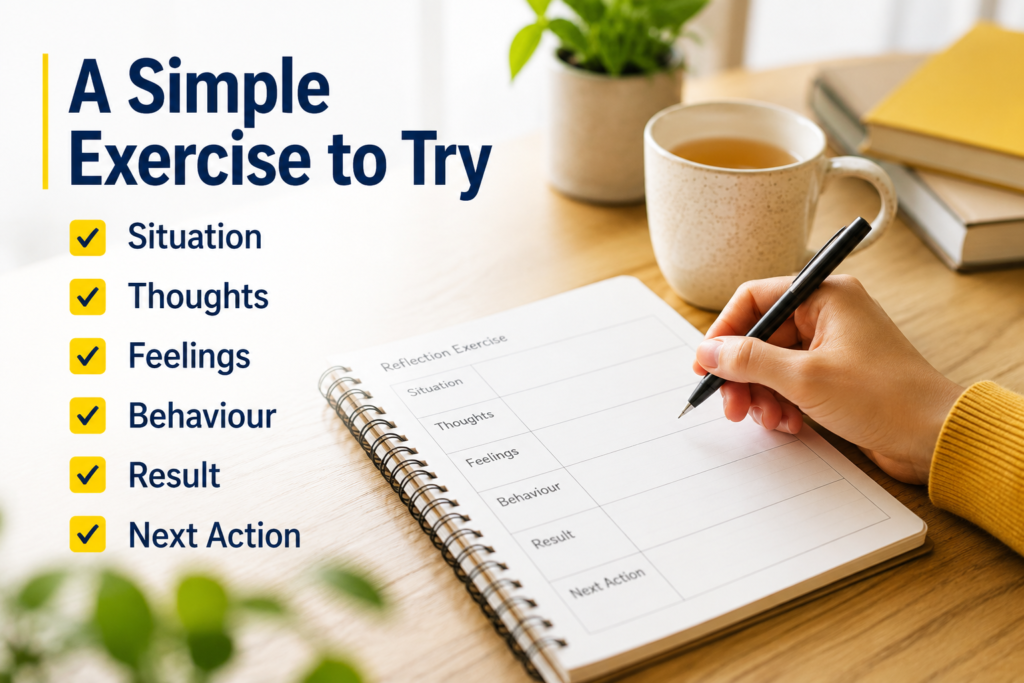
A Simple Exercise To Try
Choose one everyday situation where you feel stuck, frustrated, or avoidant.
Write down:
Situation: What happened?
Thoughts: What am I telling myself about it?
Feelings: What emotion is this creating?
Behaviour: What do I do when I feel this way?
Result: What does that behaviour create?
New thought: What is a more useful and believable way to think about this?
Next action: What is one small thing I can do from that new thought?
Do not choose the biggest, most painful problem in your life for your first attempt. Start with something ordinary. A task you are avoiding. A conversation you are overthinking. A habit you want to improve. A decision you keep circling.
Practise on the smaller things first. That is how you build the skill.
Final Thoughts
Cognitive Behavioural Coaching helps us see that our thoughts are not just background noise. They shape our feelings, our behaviour, and often the results we keep repeating.
This does not mean every problem is “all in your head.” It does not mean life is easy if you just think better thoughts. That would be far too neat, and real life is rarely neat.
But it does mean your thoughts are worth paying attention to.
When you learn to notice the meaning you are making, you gain more choice. You can pause before reacting. You can question old assumptions. You can choose a thought that is more useful, more balanced, and more likely to help you take constructive action.
You may not control every situation.
But you can often work with your response.
And that is where a lot of personal change begins.
This is one of several practical tools you can use to coach yourself through change. Visit my complete guide to self-coaching to explore the process and find the model that best suits what you are working through.
If the idea of learning how to coach yourself with practical tools and support appeals to you, add your name to the Self-Coaching Studio interest list and I’ll keep you updated as it develops.
Want Help Seeing Your Own Patterns More Clearly?
Sometimes the hardest thoughts to question are the ones we have believed for years.
If you are feeling stuck, repeating the same patterns, or struggling to move from insight into action, coaching can help you slow things down and see what is really happening underneath the behaviour.
You do not need to have everything figured out before you begin. You just need to be willing to look honestly, think differently, and take one practical next step.

Megan Ruffino is a professional life coach, Master NLP Practitioner and trainer who writes about happiness, self-coaching and personal growth. She helps people understand themselves more clearly, make conscious choices and take practical steps toward lives that feel happier and more empowered.