
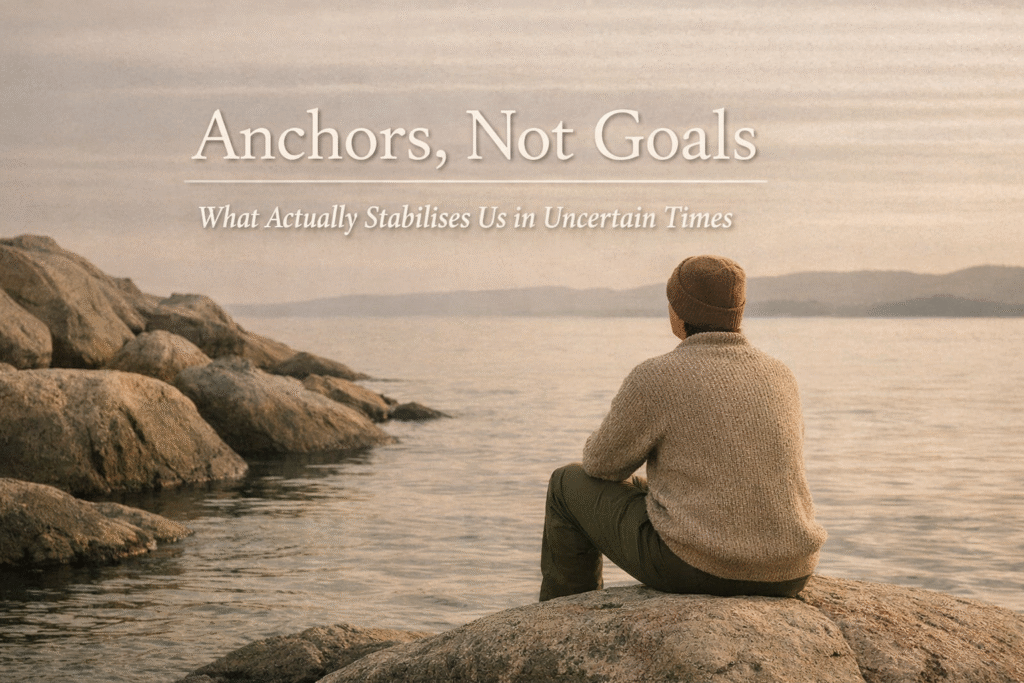
When life feels uncertain, many of us reach for goals — when what we often need instead are anchors.
We make plans. Set intentions. Try to map a way forward so things feel more controllable again. And sometimes that helps.
But in unsettled seasons, goals can also add pressure — especially when energy is low and clarity is hard to find.
What often helps more, at least initially, are anchors.
As I shared in When life knocks you off balance, stability often comes before motivation or clarity. Anchors are one of the simplest ways to create that stability when everything else feels uncertain.
Why goals can feel heavy during uncertain times
Goals are future-focused. They ask us to imagine where we’re going and who we need to be to get there.
This helps explain why motivation often disappears during difficult periods. As I explored in Why motivation disappears when life gets hard, low motivation is usually a stress response, not a lack of discipline.
When life has knocked us around, that future can feel blurry or unrealistic. Goals that once felt motivating can suddenly feel demanding, even discouraging.
It’s not that goals are wrong.
It’s that they’re often better suited to stable ground.
When the ground is still shifting, something else is needed first.
What anchors are — and why they matter more than goals right now
Anchors are the small, steady things that help you feel grounded in the present.
They don’t require ambition or momentum. They don’t depend on motivation. They simply help you feel more here, more resourced, and more capable of meeting the day you’re actually in.
Anchors might include:
- a simple morning or evening routine
- a regular walk or quiet pause
- predictable rhythms to your week
- a few non-negotiable self-care practices
- values you return to when decisions feel hard
These things don’t push you forward.
They hold you steady.
Stability before progress (again)
We often assume that stability comes after progress — once we’ve achieved something, sorted things out, or made the right decisions.
In reality, it usually works the other way around. Stability creates the conditions in which progress becomes possible.
Often, anchors invite us to slow the pace rather than push for progress. Choosing fewer demands and a more human rhythm can be deeply stabilising, as I explored in The joy of slow living in a fast world.
When stress is ongoing, the nervous system looks for safety and predictability before anything else. Australian mental health organisation Beyond Blue explains how stress affects mental wellbeing and why stabilising practices matter.
Anchors calm the nervous system. They reduce cognitive load. They make life feel more manageable. And from that place, clarity and motivation can begin to reappear — naturally, without force.
Anchors are personal, not prescriptive
One of the most important things to remember is that anchors aren’t universal.
What steadies one person might irritate another. What worked for you in the past may not work now. And that’s okay.
Letting anchors evolve over time is part of accepting that “normal” may look different now. I explored this shift more deeply in The myth of getting back to normal.
The question isn’t What should my anchors be?
It’s What reliably helps me feel a little more grounded?
Even small answers count.
When goals return, they return differently
As life begins to feel steadier, goals often re-emerge on their own — but with a different tone.
They tend to be:
- more realistic
- more aligned with current capacity
- less driven by proving something
- more supportive than demanding
Anchors don’t replace goals forever. They create a bridge back to them.
You don’t need a plan — you need something solid
If everything feels uncertain right now, you don’t need to map the next year. You don’t need a vision board or a five-step strategy.
You need something solid to come back to — daily, weekly, reliably.
Anchors give you that.
For many people, time in nature becomes one of the simplest and most reliable anchors, offering perspective and calm without requiring effort or productivity. I wrote more about this in Nature, the original antidepressant.
In the final post of this series, we’ll explore how to begin moving forward again without pressure — and how to choose next steps that honour where you are, not where you think you should be.

Megan Ruffino is a professional life coach, Master NLP Practitioner and trainer who writes about happiness, self-coaching and personal growth. She helps people understand themselves more clearly, make conscious choices and take practical steps toward lives that feel happier and more empowered.